Assistance identifying/confirming a Rushton Indian Girl?

dseielstad

Curious about Wooden Canoes
I have a puzzle I'm hoping somebody might help me solve.
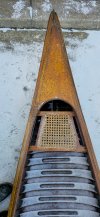
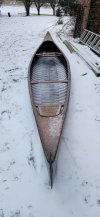
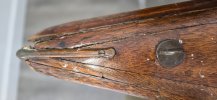
I purchased a 16ft W/C canoe - purported to be a Rushton - from Door County Wisconsin area from somebody who had gotten it from an antique auction in Missouri. The painter fitting on it is stamped "Rushton". So that's a pretty compelling story, right?

So it was generically ID'd as a Rushton from the 1930's. That's certainly wrong since Rushton ceased after 1917.
I have not tried removing varnish from the inner stem ends, but neither appear to have any numbers stamped into them.
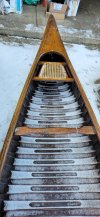
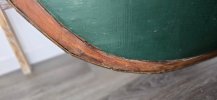
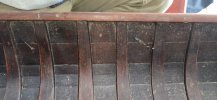
The sheer strake/plank on both sides doesn't appear to be unusually wide, which would generally be characteristic of Rushton's.
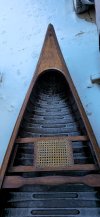
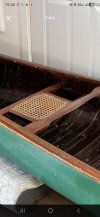
The front seat is lowered, mounted on cleats attached to the ribs which is characteristic. But then the rear seat (trapezoidal) is also mounted on cleats just an inch or so down below the inwales, and no obvious holes/plugs are visible in the inwales, so the rear cleat mounted seat was likely original.
Inwales appear to be the closed 2-piece form recessed for each rib (Grade A style or in a different source as Grade CD, but maybe not Deluxe grade?).
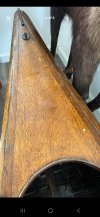
The beautiful "long" decks (which TBH are probably what forced me to buy the boat) are only ~24", single-piece decks of (possibly) mahogany, but not the 30" long capped decks which are represented in catalogs and other photos I've found.
Also strange is that the standard Rushton IG heart shaped deck is not hidden under the long deck.
The boat has wood outer stems (Deluxe grade?) and keel, and bow & stern heights are ~22" (so not an American Beauty).
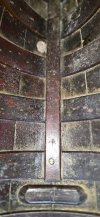
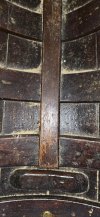
The half-rib flooring looks typical Rushton.
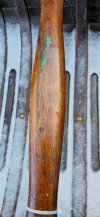
The 2 thwarts shape/cross-section look typical Rushton...but again no stamped Rushton company impression is visible on top or bottom that I can find.

It's a beautiful boat, and enough to suggest it is probably a Rushton. And I'm guessing it's possibly 1915-1917 end of production era. I don't know if the post-Rushton builders (Whistle Wing? St. Lawrence Boat?, others?) that had Indian Girl forms would have made higher grade canoes on them, but I just don't know enough about the finer details of Rushton canoes from ~110 years ago to pin this down as probably an Indian Girl built between 1900-1930's.
Any ideas for more details or clues that might better identify or narrow down this boats origins? Thanks.
Donald
 

Attachments

  • Screenshot_20260113_150118_Facebook.jpg
    Screenshot_20260113_150118_Facebook.jpg
    187.2 KB · Views: 50
  • 20260118_100910.jpg
    20260118_100910.jpg
    258.5 KB · Views: 50
  • 20260118_100848.jpg
    20260118_100848.jpg
    123 KB · Views: 40
  • 20260118_100921.jpg
    20260118_100921.jpg
    165.2 KB · Views: 36
  • 20260118_100930.jpg
    20260118_100930.jpg
    227.7 KB · Views: 36
  • 20260118_072229.jpg
    20260118_072229.jpg
    150.8 KB · Views: 37
  • 20260117_112030.jpg
    20260117_112030.jpg
    81 KB · Views: 39
  • 20260117_112056.jpg
    20260117_112056.jpg
    149.1 KB · Views: 37
  • 20260117_111750.jpg
    20260117_111750.jpg
    189.7 KB · Views: 37
  • 20260117_111400.jpg
    20260117_111400.jpg
    202.7 KB · Views: 36
  • 20260117_111029.jpg
    20260117_111029.jpg
    274.1 KB · Views: 37
  • Screenshot_20260113_150018_Facebook.jpg
    Screenshot_20260113_150018_Facebook.jpg
    102.3 KB · Views: 48
First, this style of long deck is never built with the heart shaped deck in place. That style of deck is found under the three-piece deck.
Then, the Whistle Wings do not have this much of a trapezoid stern seat. They are more rectangular and also a bit larger. Mine and many others are hung from the rails.
The seats in my Brown resemble these and are both on cleats. The Brown that Pat Smith restored has seats similar to my Brown, on cleats, but deliberately removable. The decks on Pats Brown were a somewhat clunky heart shaped deck. Mine are the same as these, nice long single piece decks as you would expect to find on a Rushton... but skillfully done by Brown. My Brown is all cherry though. My Whistle Wing is as yours, all mahogany.
Your canoe has obviously been restored at some point and that may explain why one of the thwarts appears to be a bit more clunky than a typical Rushton thwart would be, at least it appears that way in these photos. My Brown thwarts share that clunkiness. The shape is right, but that finely feathered edge you expect is not present. I suspect you have one replacement thwart.
As you note, your painter ring looks right, but the stem band looks like it is finished like the one on my Brown. I have attached it for reference. Note mine is stamped Brown.
Your stems are correct and wide as they should be.
Despite the absence of markings, I think it most resembles a Rushton but the narrow shear plank is very odd. I think that what you have is a iduno. I don't have my WW here to check if it has such a narrow shear plank. The images I have of it are not clear enough to tell but I think they are wide, as are other WW's.
It should be a nice canoe restored.

Brown
1771098077570.jpeg


WW
1771098167434.jpeg
 
Thanks for the replies.
So both of you indicate Whistle Wings continued the wide sheer plank practice of earlier Rushton IG's. So likely not a WW.
I was not familar with the Brown Boat Co. Found a link to a 1910 catalog, and it did not appear to offer W&C at that time at least. Though they certainly could have introduced later on. My stem bands dont appear to be stamped "Brown" from what I can tell.
I agree that this canoe was likely restored at some point due to the splices/repairs made to the inwales near the stems. It also appears the wales on starboard midsection weakened and and were sistered with a short patch of wood inboard. So stems may have been replaced at some stage during its lifetime.
The thwarts that are installed do seem to agree with the profile/dimensions of Rushton IG's in Mike Elliott's book, even though my photos may make them look clunky. They are certainly chunkier than Old Towns that I have.
Stamping numbers into boats a hundred years ago was such a good idea. It's just become an ineffective crutch to me with this acquisition.
And I agree that I'm looking forward to seeing what this canoe can look like in the future.
Cheers
 
The Brown that I refer to is not the same one that you have identified. Carleton (Cyce or Cyclone) Brown worked for a while as a builder in Rushtons employ. After the closing of the factory, he continued to build canoes at his farm on the Dekalb road, not far from Canton. The canoe that I mentioned that was restored by Pat Smith had been owned by one family since it was purchased from Brown. The owner recalled going to Browns home with her father to pick it. It had been built on the front porch of his house. To her recollection, this was in the 20's. Cyce did not build scads of canoes. He built to order. The canoes he built could be mistaken for Rushton canoes since he copied many of the familiar Rushtonesque details including the wide stem, shearplank, half ribs, thwarts and as is the case here, attractive single piece long decks. There were several other area builder who built canoes that resembled Rushton canoes. At this summer's assembly, Dan Miller is scheduled to make a presentation that may address some of these builders. Of course we are all familiar with SLBC, but there are other local canoe builders of whom we know very little. There was a builder in Parishville, I own a form that Atwood Manley identified as a Rushton form that my father purchased from a planing mill in Potsdam in the early 70's. To this day, there is nothing known about who was building canoes in Potsdam but add it to the list of "local" canoes that resembled Rushton canoes. Was there a Grant involved? It was the Grant street planing mill, after all, and how many planing mills have a canoe form, steam box, precut ribs and planking sitting around?
What is oddest about your canoe is the narrow shear plank. Hopefully someone with more familiarity can chime in.
One thing that might be interesting is to try looking at the bottoms of the thwarts. They may have been flipped. Maybe you will find markings there.
WRT replacing stems, Rushton stems are elm. If they are original, it is easy to identify. I don't know of many restorers who would make a replacement from elm.
 
Last edited:
Late to the party as I am traveling abroad. The first Rushton catalog that lists mahogany (Genuine Mahogany) is the circa 1916 J. W. Rushton catalog. (Long story short - after J.H. Rushton died, Harry Rushton ran the company until 1912, when he sold it to Sidney Rushton. In 1915, Judd W. Rushton took over).

Your canoe mixes features of the DeLuxe and CG model Indian Girls from this J. W. Rushton catalog. I would expect three-piece decks though.

Your canoe also is pretty consistent with the DeLuxe model IG offered by St. Lawrence Boat Works. Whistle Wing canoes was a trademark of St. Lawrence Boat works.

Both Rushton and St. Lawrence Boat Works canoes were marked with serial numbers on the stems, so you might take a bit of varnish stripper to the faces of the stems. Identifying the species used for the inside stem might help - Rushton specified red (slippery) elm, and St. Lawrence white oak.

As MGC outlined, some Rushton employees built Indian Girl canoes after the factory closed, and even perhaps as "after-hours" canoes while the factory was still open. Both Cyce Brown and Clarence Wells were known to have done this. I do not have as much familiarity with these canoes, not having seen a Brown in person (MGC owning one is a bonus), and the only Wells canoe I've seen was spatchcocked into a duck boat sort of shape :eek:.

As to the width of the sheer plank, a couple possibilities spring to mind - it could be the exception to the rule that IGs have six-inch sheer planks, or someone lowered the sheer during the last restoration. What is the depth of your canoe amidships?

You might want to have a look at my article "Poems in Cedar: Rushton Canoes of the Finest Kind" which appeared in Wooden Canoe issues 167 and 168. Back issues of Wooden Canoe are available on the members section of the main WCHA site: https://www.woodencanoe.org/
 
Whistle Wings seem to have a few very consistent features. They have (almost always lost) a WW decal on one deck, and they always have a SLBC metal ID plate mounted either on one deck, or on a coaming. If the tag is no longer present, the holes from should be easy to find. There are 4.
Lowering the sheer is something I had not considered, but to my eye, your inside rails are original except where they were spliced. I'm thinking that Dans catalog information has provided some Rushton build clues. Is this a Rushton built with a narrow sheer plank? Why not?
1771249062596.jpeg
1771249146295.jpeg
1771249280515.jpeg
 
Late to the party as I am traveling abroad. The first Rushton catalog that lists mahogany (Genuine Mahogany) is the circa 1916 J. W. Rushton catalog. (Long story short - after J.H. Rushton died, Harry Rushton ran the company until 1912, when he sold it to Sidney Rushton. In 1915, Judd W. Rushton took over).

Your canoe mixes features of the DeLuxe and CG model Indian Girls from this J. W. Rushton catalog. I would expect three-piece decks though.

Your canoe also is pretty consistent with the DeLuxe model IG offered by St. Lawrence Boat Works. Whistle Wing canoes was a trademark of St. Lawrence Boat works.

Both Rushton and St. Lawrence Boat Works canoes were marked with serial numbers on the stems, so you might take a bit of varnish stripper to the faces of the stems. Identifying the species used for the inside stem might help - Rushton specified red (slippery) elm, and St. Lawrence white oak.

As MGC outlined, some Rushton employees built Indian Girl canoes after the factory closed, and even perhaps as "after-hours" canoes while the factory was still open. Both Cyce Brown and Clarence Wells were known to have done this. I do not have as much familiarity with these canoes, not having seen a Brown in person (MGC owning one is a bonus), and the only Wells canoe I've seen was spatchcocked into a duck boat sort of shape :eek:.

As to the width of the sheer plank, a couple possibilities spring to mind - it could be the exception to the rule that IGs have six-inch sheer planks, or someone lowered the sheer during the last restoration. What is the depth of your canoe amidships?

You might want to have a look at my article "Poems in Cedar: Rushton Canoes of the Finest Kind" which appeared in Wooden Canoe issues 167 and 168. Back issues of Wooden Canoe are available on the members section of the main WCHA site: https://www.woodencanoe.org/
Thank you for your response and insights.
I agree with you that some aspects of this craft seem to follow the norms of a builder/model/grade canoes, while others seem to be a stretch to believe they are an a la carte customization (sheer plank width, 24" one-piece mahogany deck). The sheer height midship seems normal by eye with the stems, and would seem like a dramatic restoration move to take 3" off the sheer then refit all the rabbeted ribs. I will measure this though later in the week.
If it is indeed a Rushton, you are confirming my conclusion that it was likely a late model build at the end of the Rushton business, or perhaps an early post-Rushton IG build somewhere else in the late teens/early twenties. I can't find St. Lawrence Boat catalog, documentation, or details to help with the sleuthing, so will keep my eyes open and continue to work on the restoration plan for later this year
Thank you again for sharing your thoughts and knowledge.
Donald
 
Thank you, Benson.
You are correct that details are limited, but my boat is at least consistent with the details shared from that single description. I'm leaning more toward the SLBC 16ft WW DeLuxe grade at this point. 23" single-piece decks, the general ht of stems and center depth, lack of extra wide sheer plank, and at deck material of mahogany (I believe).
I'll have to go learn wood identification 101 to have some confidence on materials used for stems, rails, seats/thwarts to have some more confidence, but this page and previous points made on details from C.Brown craft and some other distinctions on stem materials all will help to silver this puzzle.
Thank you to all that have chimed in (so far).
D-
 
Back
Top