Unknown Canoe Help - possible circular deck plate/logo

Murat V

LOVES Wooden Canoes
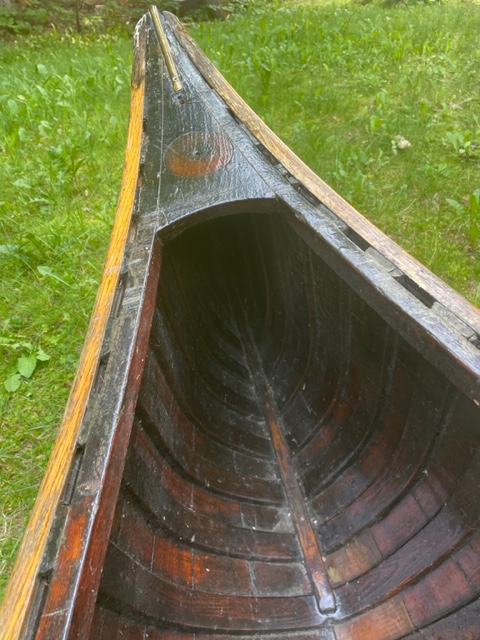
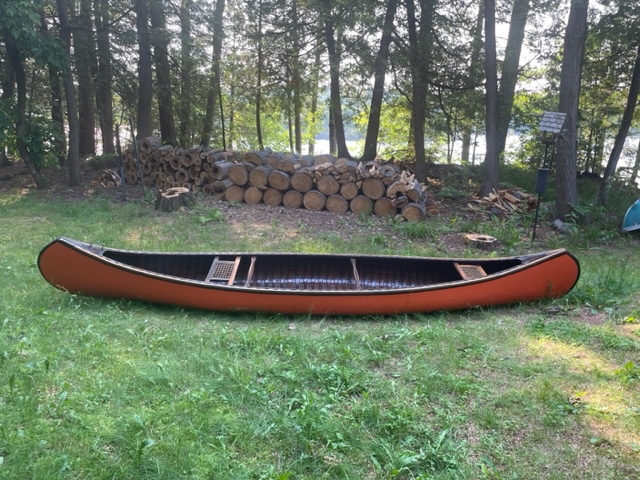
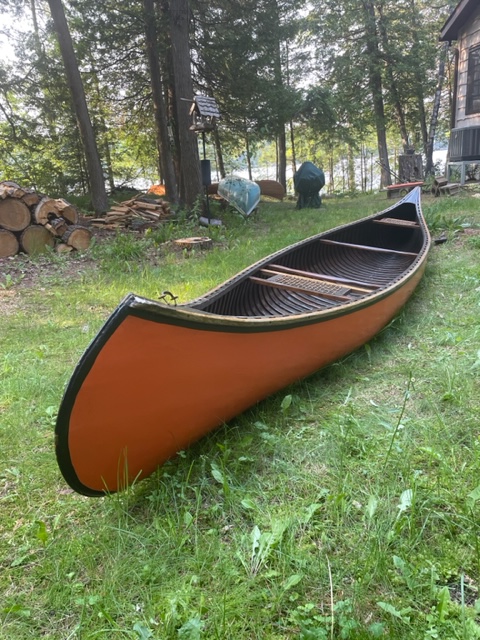
Posting on behalf of a visitor who came to our Chapter booth at last weekend's Rideau Paddlefest. He's seeking any info on the possible maker of his canoe. Apparently, it was picked up in Toronto in 1982 and then sat in his garage for 30 years. It was then restored by Dave Standfield of Taylor Statten Camps in Algonquin Park. A deck was replaced, the canoe re-canvassed and painted in the Camp Ahmek orange and black theme.

• 15'11" long
• 32" beam at gunnels
• No markings/serial numbers
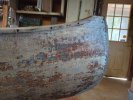
• very round outward stem profile
• two thwarts, one behind bow seat other is aft of center
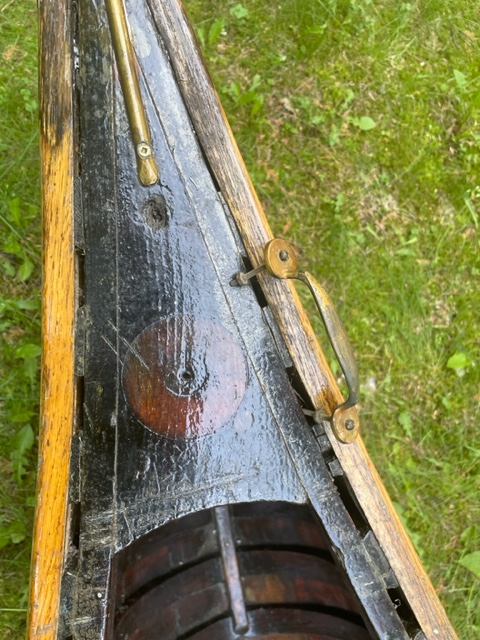
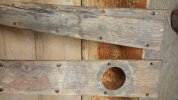
• semi-circular deck shape with what appears to be a large round spot where perhaps a plate or decal might have been positioned. A strange brass handle seems to have been mounted creating two distinct holes.
IMG_3817.jpg

IMG_3816.jpg


IMG_3813.jpg

IMG_3814.jpg
 
Last edited:
Thanks Benson. I wasn't aware that W.T. Bush made canvas canoes, especially given the early range listed as a builder. The surviving advertisements I've sourced for them only show all-wooden construction. The Orillia Heritage Centre has a board-and-batten Bush sailing canoe in their collection...

2019-07-13-leacock-vintage-boat-show-2 - WT Bush.jpg


What's odd about the decks in the first post is that both of them have remnants of the same sized circular spot. Have you ever head of a maker commonly putting the same decal / metal deck plate on both the bow and stern decks before?
 
I researched WT Bush extensively, neither a bush canoe nor decal. Dick Persson has the majority of ephemera I collected, including the last 2 water slides that are now reproduced along with a wide board building form
Cheers,
 
Have you ever head of a maker commonly putting the same decal / metal deck plate on both the bow and stern decks before?

No, I don't ever recall seeing a maker who put the same decal or deck plate on both the bow and stern.

Benson
 
Wondering if the folks here can concur that the exaggerated stem profiles and off-set thwarts likely means this was some sort of "pleasure" class of canoe. Perhaps the odd circular imprints on both decks were from metal plate/decals from a livery operation of some sort. Might also explain why brass handles were put on each deck as well. Anyway, still awaiting more details and closeup photos from the owner and will hopefully get more clues.
 
That spot looks more like where a metal or wooden disc was once attached - there is a ridge of varnish around the perimeter, and there is far less darkening within the circle than around it. Plus if one deck has been replaced yet both decks have the same circle, it seems unlikely that this was caused by original decals. The handle isn't mounted to the gunwale; it's just sitting there.
 
Certainly looks Canadian built, but i would guess from a smaller builder as it doesnt seem to be a Peterborough or Chestnut, perhaps an early Canadian Canoe Co, early Langford, or one of the many regional small builders. Too much stem recurve and the thwart placement is odd, maybe even an earlier Rice Lake or similar.
 
I think this is what I have. It was not originally canvassed. In orginal shape it had a name in block letters..
QUIN**AUG I'm not certain what the originally spelled. Painted inside and out light brown or tan.
QUIN*DAUG?? Yes, Coldwater, Ontario. QUINNDAUG? What's that?
 

Attachments

  • 1766706031494.jpeg
    1766706031494.jpeg
    163.5 KB · Views: 48
  • IMG_20251225_172622175.jpg
    IMG_20251225_172622175.jpg
    129.5 KB · Views: 47
  • IMG_20251225_172645019.jpg
    IMG_20251225_172645019.jpg
    145.3 KB · Views: 45
  • IMG_20240412_153739692_HDR.jpg
    IMG_20240412_153739692_HDR.jpg
    184.9 KB · Views: 46
Last edited:
Thanks Benson. I wasn't aware that W.T. Bush made canvas canoes, especially given the early range listed as a builder. The surviving advertisements I've sourced for them only show all-wooden construction. The Orillia Heritage Centre has a board-and-batten Bush sailing canoe in their collection...

View attachment 53608

What's odd about the decks in the first post is that both of them have remnants of the same sized circular spot. Have you ever head of a maker commonly putting the same decal / metal deck plate on both the bow and stern decks before?
That Orillia Heritage Centre WT Bush looks like mine. Mine was canvased sometime after it was built. The canvas was tacked on without removing the outer (and only) wale.
 
That canoe that you got from me is a WT Bush wideboard that came from Quinabaug Island not far from our old place. Was purchased by the owner who was originally from Long Island NY and initially travelled by rail and steamer in the early 1900s. Never stripped it, that’s interesting.
 
That canoe that you got from me is a WT Bush wideboard that came from Quinabaug Island not far from our old place. Was purchased by the owner who was originally from Long Island NY and initially travelled by rail and steamer in the early 1900s. Never stripped it, that’s interesting.
Thank you Andre. I thought it was you. 2010 was when I started with wood canoes. That WT Bush was rough and I put it aside until I had more experience. Now's the time. Yes, the canoe was originally painted and I saw the name but it was dim. I guessed it was a location but I couldn't identify the exact name. Good that you remembered. The spelling "Quinabaug" only shows up on mapquest in Vermont. Nothing in Ontario. If Bush stopped making canoes in 1905 then this is the oldest canoe I have.
I'm planning to repaint it in the original tan color that'll cover up the extensive filler I'm using. This is the second boat I found with only a rear seat. Generally, the abscence of a front seat means it was a work boat likely a trapper. Certainly not for two. Is Quinabaug a French name?
 
It looks like your WT Bush canoe may have paint on top of varnish, as though it were originally varnished and later overpainted. Is it fastened with iron or rather with brass or copper? You're probably aware that lower grade canoes were often iron-fastened and then painted; higher-grade canoes were fastened with brass or copper and then varnished. Anyway, given that the wood looks so nice (doesn't look like paint is embedded in the grain) and Bush canoes are so rare, one option would be to apply two or more coats of varnish and then paint on top of the varnish. This way, if you or someone else were to someday re-restored the canoe, it could again be stripped down to bare wood and restored with a varnish finish.

About seats, these earlier all-wood Canadian canoes often had no seats or only a rear seat that was mounted on cleats. I never thought of the ones with rear seats being work boats, but perhaps. I thought adding a seat would have been an upgrade for a gentleman to more comfortably paddle his lady as she reclined with a backrest and cushions. Just my speculation...
 
Last edited:
Just a hunch, but Quinabaug sounds Native American to me. On Long Island NY there are many old names ending in "og" sounds spelled "auge" or "ouge" and I've heard it means water.
 
Is Quinabaug a French name?

The page at the link below says it means "long pond" and was common in the Native American languages of southern New England.

Benson


The page at the link below says it means "long pond" and was common in the Native American languages of southern New England.

Benson


Thank you Benson. I'm native to Puget Sound, WA and BC. I don't recognize names or trees from the eastern areas. Andre would know more about this canoe and it's origin than I. I'm just happy to make progress. It's an odd boat that I've had for 15 years. Restoring these old canoes takes some skill. It's not like furniture. I don't like replacing boards but rather splice and repair. In this case, I did learn that the trees this canoe came from are mostly gone. Some disease got them. If I replace boards I can't get the same wood. I've salvaged old growth logs out west. Those trees will never grow again in this era. I've watched mills in WA adjust their head saw down to cut everything below 32 inches. You can't even sell a log as big as what was found on this continent in late 1800's.
 
Just a hunch, but Quinabaug sounds Native American to me. On Long Island NY there are many old names ending in "og" sounds spelled "auge" or "ouge" and I've heard it means water.
Thanks John. As you see, you are correct. I imagine the original builders stenciled the name. It's well done.
 
Back
Top