
You are using an out of date browser. It may not display this or other websites correctly.
You should upgrade or use an alternative browser.
You should upgrade or use an alternative browser.
Unknown Canoe Help - possible circular deck plate/logo
- Thread starter Murat V
- Start date


Treewater
Wooden Canoes are in the Blood
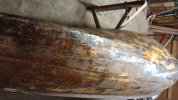
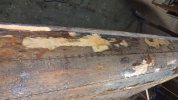
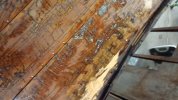
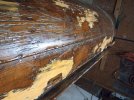
I'm not proud of the rib repairs but they are done. I'm thinning floor polyurethane to coat the exterior hull. I filled the deep gouges but every plank is scarred. When I'm satisfied it will float I'll coat it to cover the puddy.
Attachments
Treewater
Wooden Canoes are in the Blood
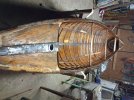
I'm leaving the country. I'm glad I got the canoe to this point. Several ideas about covering the filler. If I make it back I'll get it done. If I don't return there'll be about 8 canoes and 15 folding kayaks/ boats for sale. Here's where the Bush is at.
Attachments

Dan Lindberg
Ex Wood Hoarder
Michael,
It would be good to not lose this,
could you post this over in the "info" part of the site?
Dan
It would be good to not lose this,
could you post this over in the "info" part of the site?
Dan
To add some details and photos:
All-wood canoes were built in a wide variety of manners, especially if you add into the mix builders from the US and Europe. The old Canadian builders themselves produced a variety of kinds of all-wood canoes, and their history evolution began long before the Peterborough Canoe Company started in 1892. Canadian all-wood canoes included:
1. Rib and batten canoes, also known as wide-board canoes such as the Bush being discussed here. These are most often seen with basswood planking, though they were also built of cedar, cypress or mahogany, with widely-spaced interior ribs. The battens are made of rib stock.
View attachment 60993
14' Peterborough rib and batten
2. Metallic joint canoes, in which wide boards were joined along their edges with brass or copper strips, somewhat like an extremely long staple that runs the full length of each joint from bow to stern. The battens are visible between the narrow ribs lying interior to the planking and battens.
View attachment 60989
Metallic joint
3. Flush batten canoes. Built like metallic joint canoes except that w wooden batten is used. It is half the planking thickness and is mounted into a rabbet that runs along each interior plank edge.
View attachment 60988
15' Lakefield flush batten
4. Double cedar canoes. Made by Dan Herald, Herald Bros, and then the Rice Lake Canoe Company. These have wide exterior planking running lengthwise, narrower inner planking (about 4” wide) running gunwale to gunwale, and a resin-impregnated muslin layer in between the two layers of planking. There are no ribs in this construction, though sometimes the interior planking has been referred to as “ribs.”
View attachment 60992
15' Daniel Herald patent double cedar
5. Cedar rib canoes. These have a single layer of planking running gunwale to gunwale, and these “ribs” mate with each other via tiny tongue-and-groove joints. Along with the gunwales and keel, lengthwise hardwood battens held everything together with a fastener through each “rib” each the batten.
View attachment 60991
16' Peterborough cedar rib
6. Longitudinal strip canoes. Numerous narrow ribs with narrow lengthwise planking nailed on, each plank joining the other via half-lap joints. Sometimes they were made with alternating species of wood to produce the pattern shown here (sometimes called "candy stripe" today).
View attachment 60994
16' Canadian Canoe Co. longitudinal strip
Generally, all-wood canoes were just that – wooden hulls without canvas covering. However, it is possible that all-wood canoes could be covered with canvas from the factory, and they certainly have been covered sometimes by users and restorers. The usual factory-made canvas-covered Canadian canoes were built just as American cedar-canvas canoes were, with thin cedar planking tacked to wide cedar ribs, after which canvas is stretched on and waterproofed.
Some canoe models from Canadian builders were available in a variety of construction methods. For example, you might purchase a given Peterborough model in rib-and-batten, longitudinal strip, or cedar-canvas construction:
View attachment 60995
View attachment 60996