Hello Jess, and welcome to the wonderful world of miniature and display sample canoes. I have sent you a PM which got slightly delayed because of a mix-up in your email address.
Over the years, I have owned three Kennebec samples, two of which were similar to yours, and one which was more like that owned by Zachary Smith. Additionally, I have been involved in the sale of two more, again like yours. I would agree with the comments already posted by colleagues above.
You have already done some considerable research into the background and provenance of this particular sample canoe, and I would agree that it all makes sense and would appear quite plausible. You would be wise to print out this info and place a copy with the canoe so that others will have this record in future. Such provenance enhances its value and the document will ensure its preservation.
Here is what I believe can be said about Kennebec sample canoes:
The production records of the Kennebec Canoe Co. have been preserved and stored at the Maine State Museum. According to research done by Dan Miller, it appears that Kennebec produced ten "5 foot miniature canoes" in 1916; then, after a 5-year hiatus, it produced another ten each year from 1921 to 1926, inclusive. That is, some 60 in all. In my personal collecting experience, these samples have been found in either a 66" length, or a 69" length. This is the maximum full length as measured in a straight line end to end. My personal experience suggests to me that the 66" length samples probably came first, in 1916, and that the slightly longer 69" length samples date to the 1921-1926 period. The shorter length are quite robust, almost 'blocky' looking, while the longer are more curvaceous with high ends and less-deep sides. The longer samples have been found with paint details more common to the twenties than the teens. Admittedly, some of this is personal speculation or interpretation, but based upon what I have encountered myself, as well as those found by others.
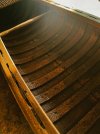
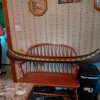
I believe that your sample should be regarded as belonging to the 69" group. Try measuring from very end of curved stems, not just from tip of ends. It has typical, original 'basket weave-type' seats as seen in other Kennebec samples. The gunnel caps at the ends taper to a point as do all the other 69" Kennebec samples I have known; on the 66" Kennebec samples, the gunnel caps end in blunt, slightly angled 'spade-like' shape. The thwarts in all the 69" samples I have known are well shaped, even somewhat delicate. Those in the 66" length are more rugged. Your canoe also definitely has that curvaceous '1920's' look and feel, especially with its paint detail.
I am not aware of any other Kennebec samples having four holes along the bottom; this may well have more to do with how your sample was mounted and/or displayed. This likely occurred post factory release.
As to how or why Kennebec came to produce smaller sample canoes, that again is a matter of some conjecture. I believe this has to be looked at in the context of canoe production in Maine, in the early years of the 20th C. Benson Gray, a great-grandson of one of the founders of the Old Town Canoe Co. is much more knowledgeable than I, and may wish to add more. But, briefly put, the making of sample canoes was not generally a widespread canoe industry practice until the Old Town Canoe Co. came along. Before that (1903), not many factories seem to have produced much more than a handful or so; there was very limited production. Some factories are not known to have produced any, while two companies located nearby Old Town (Carleton and E M White) produced perhaps 20 or so, each. However, the Gray brothers at Old Town Canoe Co. were aggressive marketers and promoters of their products. They developed a practice of awarding sample canoes of 4' and 8' lengths to their very best and largest buyers, the major outlet stores. It is said that if a store submitted a winter order of roughly 40 full-size canoes (enough to fill a railway boxcar), Old Town would award a 4' sample as a premium, a special 'Thank you'. If the order was for 80 full-size canoes, the award would be either two 4' samples or an 8' sample. It was marketing genius, and the little samples were well appreciated and eye-catching, often being hung up in salesrooms, or placed in window displays. They were never produced or handed out as 'salesman's samples'. Over the years between approximately 1905-1930, Old Town Canoe Co. distributed an estimated 130 or so display samples (probably about 70 so in the 4' length, maybe 50 in the 8' length, and a dozen or so "sign canoes' of anywhere from 10' to 14'. Record-keeping was inconsistent and exact production numbers are uncertain; these figures are 'best guesstimates'. Old Town was fast becoming the major producer of canoes in the USA. Why is this important?
It was against this background that George Terry commenced his Kennebec Canoe Co. operations in 1910. It seems he was determined to challenge Old Town Canoe and its dominance, in Maine. He seems to have built and distributed samples in parallel to Old Town as part of his competitive effort. (In a more minor fashion, Carleton and White had done the same). The hey-day of sample production at Old Town was during the 19-teens and twenties. Kennebec's production of miniature display canoes neatly coincides with this (1916 to 1926). Old Town's production of samples dwindled markedly after 1930 or so. Kennebec is not known (at least not recorded) to have made samples after 1926; indeed, it went out of business in 1942, after weathering the Depression and advent of WWII. So, that will give you some context of the era in which your canoe was created, and how and why it came to be.
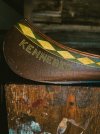
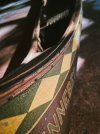
The paint detail on your sample is, as others have said, truly outstanding; it is the finest Kennebec sample I have ever seen and quite striking.
Kennebec sample canoes have value. Old Town samples have been the most sought after and have brought prices in the 5-figure range, and one which has even sold for US$123,000. Mostly though, they currently are bringing in the $20K to $50K range. Kennebec samples are not far behind; the best have so far brought in the lower $20K range. Of course, this all depends upon condition and originality. But even worn examples have brought $7K-$8K, and well-restored examples around $15,000. Your sample is well worth caring for and giving appropriate attention. It would appear to be in original, aged condition, and basically untouched over the years. I would leave it as is. It is charming and, if offered in an elite auction sale, I have no doubt that it would command a record price. You are indeed most fortunate to have come into possession of such a piece.
Thank you for letting us know about your charming canoe. Don't hesitate to ask if you wish further input.
Cheers.


 E8670ADB-EF1E-4567-A0C9-26C783789892.jpeg433.2 KB · Views: 62
 7A649ED1-86CB-438B-B7C5-0AF5ECE4891B.jpeg437.5 KB · Views: 59
 479ACCC5-7B58-4620-BDED-CB4CFB2CA024.jpeg461.2 KB · Views: 54
 E2A2B6D2-30B3-48DB-A074-73492183F045.jpeg462.8 KB · Views: 48
 DDE699A7-D9D9-49FA-A9D0-FFE44D08DEFB.jpeg402.7 KB · Views: 47
 B590A0BE-7D9A-47DD-B05A-C0CA59B242C0.jpeg542.9 KB · Views: 49
 att.ObX68eT3KglCDzzblz21Uqbml0x2L7MN1SI0rzhpBbw.jpeg384.1 KB · Views: 64


