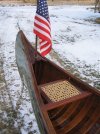
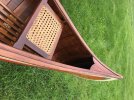
Old Town seat frames

patrick corry

solo canoeist
Is there a period correct treatment for the frame members on a 1938 era Old Town Canoe seat? I have made the frames from air-dried Ash (noted as the species on the original build sheet) but I'm unsure about the treatment of the corners of the frame components. Leave 'em square, small round over, larger radius round over, chamfer? I have made them square for Chestnuts,
67563339729__549D4727-AB81-4F9A-B721-95B99630B83D.jpeg
and here a solo seat for my Island Falls Willow which has a stopped round over shown here:
IMG_7436.jpeg
Or... is this larger round over posted by Dave Osborn in a 2016 post more appropriate?
Image 14.jpeg


Here are the frames; still to be sanded prior to final detail. By the way, I chose to join the rails & spreaders with loose tenons using a Festool domino tool which worked quite well!


IMG_3087.jpeg

IMG_3075.jpeg
 
I would encourage you to round them like Dave's picture. The image below shows the the Old Town canoe seat from serial number 125927 which is slightly less than your serial number.

Benson


1764884744777.png
 
Yep, just like the seat in the image from Dave Osborne - appropriate throughout that time period. Note that sometimes they had corner holes and sometimes not, so either way is fine.
 
sometimes they had corner holes and sometimes not, so either way is fine.
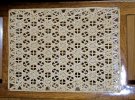
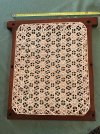
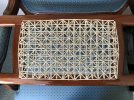
Yes, I did notice this on the pictured frame. On a purely aesthetic note, the lack of a corner hole appears out of character with the right angle of the frame. Without the corner hole the cane must make a 45° angle across the 90° corner. Also, without the corner hole the pattern lacks the two converging diagonal canes pictured in my first two pictures. I did say aesthetics.... or maybe I should have said "obsession with minutiae"?
 
Your first picture caning pattern is impressive!
Thank you Todd. The pattern in the first picture is that used by the Chestnut Canoe Co. of Canada. It's remarkably similar to the second picture, but differs only in that the vertical and horizontal strands do not "weave" at their intersections. Other than that the process is the same and perhaps takes less time. Digging deeper into the weeds, I think but I'm not sure, that the Peterborough Canoe Co. used a similar pattern except that the diagonals crossed over the verticals and under the horizontals rather than the way Chestnut did it. Maybe this is true, and maybe I made it up.... I can't remember all my lies!!
 
Personally, I wouldn't obsess over caning patterns. Most of these canoes aren't exceptionally rare or historically important, and I've seen what I've seen seats from the same maker, same timeframe, with different patterns of original cane. Individuals did the caning, and at least with some companies it is said that this was piecework done at home. Thus caning patterns varied. And if seats were ever re-caned, different patterns could obscure what was done by a given builder. Finally, just as paint color can easily be changed, it's not a big deal if you want to re-cane someday. I see no problem with using a preferred method/pattern. In a canoe intended to look period-correct, I wouldn't put in an outrageously complicated pattern that would look out of place but among the styles above, all seem to be reasonable for most older cedar-canvas canoes.
 
Back
Top