Old Town 50 Pounder complete

Howie

Wooden Canoes are in the Blood
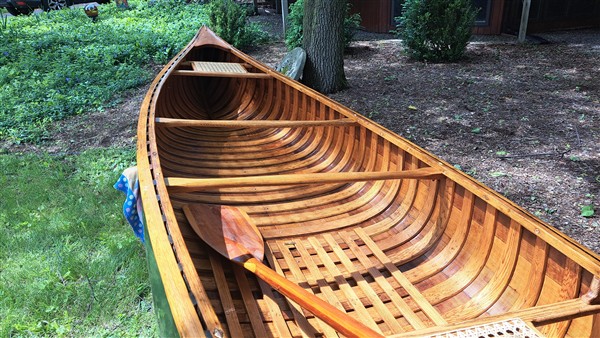
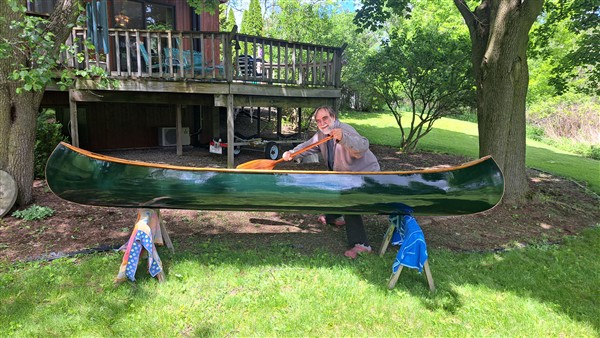
Just finished the 1936 13' OldTown '50 Pounder' I picked up last December. My 51st restoration! Came out nice. As you can see, I'm eager to get it wet asap.
20260528_142805.jpg


I covered this one with Dacron (my 3rd use of Dacron). Weighs all of 53#, even with a little floor rack I added (which added 2#). OldTown literature in at least one catalogue listed the 13 footer as weighing 50#. Nonsense: I suspect the truth is they weighed closer to 60#.

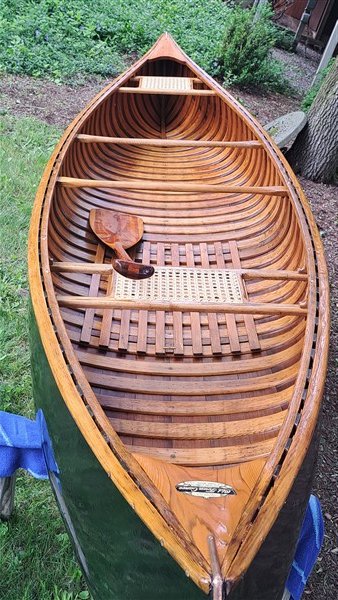
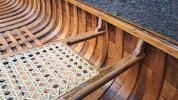
I had to replace 3 ribs at the center of the canoe. They were all broken along one side but the center portion was fine. Since they were already perfectly curved to fit the floor of the canoe, as well as the right thickness, they were perfect for the base of a short removable floor rack. I positioned the rack just behind the front seat 'cause that's where my feet will be as I'll be paddling the canoe 'facing backwards'. This 50 Pounder was made with slightly thinner ribs and planking, so I figure the floor rack will give the canoe some extra strength in this area. I also added a 2nd thwart and positioned the two left & right of center as I prefer to lift the canoe by the thwarts rather than from the rails.
20260528_143317.jpg
20260528_143549.jpg


Forgive the little seat spacers I made. It was winter. I was bored... I also replaced the original seats which used machine-made cane. I much prefer hand woven cane.
20260528_143655.jpg
 

Attachments

  • 20260528_143257.jpg
    20260528_143257.jpg
    100.3 KB · Views: 100
Last edited:
Lovely!
What kind of filler did you use on the Dacron?
I used Kilz as it's advertised to stick to anything.

Since you asked, let me tell you the two problems I ran into. I used the same 1/8" I use with paint, and this worked well with Kilz as well - you just need to work fast as Kilz dries quickly. My 1st problem was that I didn't use enough Kilz to fully cover the Dacron 'weave'. This resulted in a patchy 1st coat paint job: It looked good where enough Kilz had been used to cover the weave, but looked awful where the weave could be seen. It kinda looked like the paint sank into the 'holes' in the weave while adhering normally to the higher parts of the weave, with the result being that the weave pattern was exaggerated. My 2nd problem was to sand the 1st coat too aggressively - this just exacerbated the problem with the weave. So what I ended up doing was to sand lightly sand the areas where the weave was visible, and then re-paint in just these areas. I did this three times, at which point the weave was much less visible. And then I lightly re-sanded the whole canoe two more times. The result was acceptable (to me anyway).

Applying the Dacron and shrinking it was a little time consuming but quite do-able - as long as you watch the iron temperature.
 
Last edited:
Oh, that sounds familiar!
I used Kilz 2 and can see a hint of the weave under the paint. My fault, because one more coat of Kilz is all it needed....
 
Lovely little canoe. I sense that these 13’ 50#ers are desirable, I guess because they are less cumbersome to manage. But do they paddle well? The length/width ratio can’t be ideal for speed or tracking I suspect.

What paint color & manufacturer? I’ve only painted one canoe green; Kirby’s #12 Bottle Green.
 
Lovely little canoe. I sense that these 13’ 50#ers are desirable, I guess because they are less cumbersome to manage. But do they paddle well?
As with all things canoe, its a matter of taste and preference. For someone running a trap line, one of these could be pretty handy. They are easy to schlep around, can be navigated in beaver ponds and winding small streams, but for "proper" paddling, they are a bit like a floating bathtub. Personally, I prefer the lines of canoes 16 feet or longer for ideal paddling, some of the 15's are OK but most are right on the bubble.
Shorter modern hulls tend to be much better designs in the shorter lengths as you can see if you check out the many different "pack" boats that are on the market.
But, as noted, a matter of taste and preference. Just like the color choices, to each their own.
 
Patrick:
The paint was Epifane's Deep Green
As to how it paddles: Just took it out today. Yay - it's as good as I remember.
I've paddled both the 11ft and 13ft 50 Pounders, as well as 15', 16', 17', 18'. Clearly the attraction of the 11' & 13' canoes is their lighter weight (as well as classic good looks). They are easier to lug around out-of-water. As you might expect, both canoes are highly maneuverable. The 11ft-er turns on a dime, which is its biggest problem: I really needed to concentrate on my J-stroke to make any forward progress. It took so much concentration and constant course correction that I didn't have much fun paddling it. I suspect a kayak type double-bladed paddle would have made it more fun.
I found/find the 13ft-er to be much easier to handle, and a lot of fun. A good J-stroke is essential, but its much easier to paddle in a straight-ish line. And I had no trouble staying up-right. That's the benefit of a good hull design. But this is my solo-paddling canoe; it'd be hard pressed to take two adults. When paddling with a partner a longer canoe is better - especially if they can help lug it around.
 
I recognized that Epifanes Deep Green immediately when you first posted the photos. It is such a unique color (Epifanes has some interestingly different colors). Their Deep Green is like a very dark olive that looks black in certain light. I have it on one of my favorite canoes, a Morris Model A Type 3, and I have put it on others. I really like it but in small doses - wouldn't want to use it too often. As much as I do enjoy it, there's something somehow unsettling about it to my eye. Don't know why or how to describe it, but it's there.
 
Back
Top