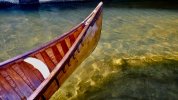
The big golden thing in the sky arrived in the UK today so that gave an opportunity to get on with the birchbark as the temperature reached a barmy 17 C ( 62F in old money) which would make it easier to apply the gum which I had made up previously. I was going to hit the gores and the stems today.
Firstly I dropped the canoe down from the rafters and got all the gear ready on a table outside just in case of a flare up! I used Angelikas best non stick pan , a wooden spoon and heated it up on a camping stove.
My gum was still quite light in colour so I added some more pitch pine resin to it to darken it down. I kept some back as I will use a lighter shade for small areas on the bark.
This is what the gores looked like before I started.
This is an area on the bark where the reserved, light gum will be added.
I heated the gum up and got it nice and runny before taking it off the heat and letting it cool until it would run off the spoon like treacle and starting at the top of each gore I ran it into the joint. Of course at one point I splashed myself and it's remarkable how quickly hot gum can remove skin and flesh! There is also a delayed reaction between eye and brain when you are watching your flesh sizzle and do nothing about it...ho hum.
Henri had suggested spitting on my thumb and rubbing the gum into the gores; I opted not to burn myself further so used a leather iron. I heated this up and then took the power off and let it cool slightly before applying it to the new and old gum which melted nicely into each other and with some pressure, a smooth finish was achieved.
Uing the iron has at least enabled me to maintain my thumb and finger prints which I suspect many birchbark canoe builders now lack.
Here are the smoothed and finished gores
I then moved onto the stems. The front was generally good so I just smoothed that with some heat whilst at the stern I dribbled some gum down, mixed it with the original and got a good coverage over the cloth which Henri had used.
So after a couple of hours the gores and stems were done. I then went over and melted and spread some of the lighter bark patches; I will add some more light coloured gum to those and the areas over the next day or so as the temperature is predicted to stay at similar levels.
Once I have finished the gum I will replace the missing root bindings at the prows. I am not happy with the cane I tried so am going down the road of using some leather cord which I found and which should look good and do the job.
This is the leather cord which I found.
That's all for now. I'm off to make friends with the pot of Sudocrem...........You plonker Nick!