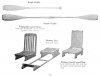
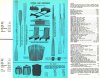
Old Town Rowing Seat w/ Foot Brace

Howie

Wooden Canoes are in the Blood
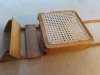
Got bored with the snow & cold so I refinished this rowing seat & foot brace. It came with a 1906 OT HW project I picked up a few months ago. The seat straddles the rails which measure 12 7/8" wide & 48" long. The seat itself measures 15 1/2" wide & 14 5/8" deep and can be placed anywhere you like atop the rails.
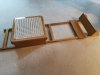
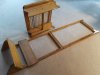
20171231_121915.jpg 20171231_122131.jpg 20171231_122149.jpg20171231_122053.jpg20170928_102956.jpg20170928_102948.jpg
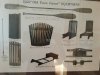
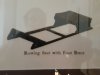
I've included a picture from a poster I have which shows various Old Town paraphernalia, including this 'Rowing Seat with Foot Brace'. Anybody know when Old Town offered them?

I don't intend to use it myself so I'll be putting it up in the WCHA Classifieds section. I'm thinking that in addition to being used for rowing it might also be nice to use as an extra seat in the center of longer canoes. It might also be used in canoes where the rear seat has been removed as it significantly lowers a paddler's center of gravity thereby the canoe's stability.

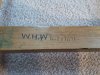
O - Anybody know of a H.W.Whilehill? He carved his name in two places into the wood. I assume he was from the NY Adirondacks area as that's where the canoe was found. Interestingly, the canoe that came with it was delivered to Paul Smith Station back in 1906 which was located very near where the WCHA assembly is held today.
 
Howie, Did you perchance sell your rowing seat yet? Would you have a tracing of the seat support profile or at least the height? Sincerely Bob F.
 
I need one of these for my 1924 OT double ender. Also, foot rack and seats. Anybody know of plans somewhere to build them?
 
So I have to make one. A seat. I have the foot brace. The photos I find only have the flat seat without a back on the foot brace. I'm wondering if the seats with the folding backrests also were made to go on the foot brace frame? Otherwise they would just sit in the bottom of the canoe? I'd like to make a seat with a back rest and use the foot brace. Don't see why I couldn't ? any opinion? Thanks, Dave
 
I'm wondering if the seats with the folding backrests also were made to go on the foot brace frame? Otherwise they would just sit in the bottom of the canoe?

It depends on how you want to use it. The seat and foot brace was designed for rowing which commonly involves leaning back further than a back rest would easily allow. If you just want to have someone sit with a place to rest their feet then your alternative should work fine.

Benson
 
Yes, I think this will be rowed , sponsons and oarlocks. So maybe I'll just make the seat only. your right maybe not being able to lean back further on a stroke could be a problem. thanks.
 
Reviving a dead thread looking for a little more information on this “Rowing Seat with Footrest”. How do the rails lock into the canoe so the whole assembly doesn’t slide around while rowing?
 
I've forgotten. But seems to me that the bottom of the frame would have a 'nub' at each of the frame's four corners that fit between the canoe's ribs. These nubs must be not be taller than the thickness of the ribs as you want all the weight to rest on the tops of the ribs and not on any part of the planking. If these nubs don't exist you could screw in 4 small rubber bumpers - like shown below.

1786534270393.png
 
How do the rails lock into the canoe so the whole assembly doesn’t slide around while rowing?

Gravity is usually the primary force securing them. The weight of the rower is typically enough to keep them from sliding around. Blocks can be added to the bottom and spaced so that they fall between the ribs as Howie suggested. Small strips of non-skid rubber can also help.

Benson
 
I've forgotten. But seems to me that the bottom of the frame would have a 'nub' at each of the frame's four corners that fit between the canoe's ribs. These nubs must be not be taller than the thickness of the ribs as you want all the weight to rest on the tops of the ribs and not on any part of the planking. If these nubs don't exist you could screw in 4 small rubber bumpers - like shown below.

View attachment 62796

Gravity is usually the primary force securing them. The weight of the rower is typically enough to keep them from sliding around. Blocks can be added to the bottom and spaced so that they fall between the ribs as Howie suggested. Small strips of non-skid rubber can also help.

Benson
Thank you gentlemen. I’m asking because I’m thinking about making the rowing seat for my 1942 17’ OTCA, not to be used as a row boat conversion, but as a center seat for paddling solo.
 
Back
Top