New Member, Old Canoe Identification/Recommendations

Sven Yohnson

Curious about Wooden Canoes
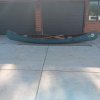
I recently aquired an old canvas on wood canoe that I would like help in identifying the manufacturer and approximate age of.
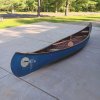
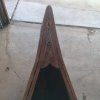
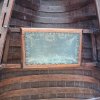
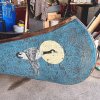
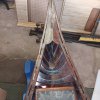
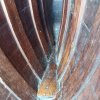
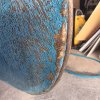
The canoe had been owned by a gentleman from Anoka, MN since the early 1950's. The paperwork I received at time of purchase lists it as a 1950 Old Town, which I do not believe it is, due to deck design, and as there are no tags, or serial number common to Old Town models. It is 16' OL x 36"W with a very pronounced 3"+ rocker (definately a river boat). The canvas appears to be original, or a very old recover, with original paint (sky blue), and a hand painted bow logo of a Canadian Goose in flight over a full moon (see attached photos).
In addition to identification, I am looking for recommendations on how, and what to use as a clear protective hull coating. I wish to waterproof the boat for occassional use, while maintaining its original patina. I am planning to coat he interior, decks, gunwhales, thwarts, and seats with a 50/50 mixture of linseed oil, and mineral spirits (unless there are better options available).
I think that's enough to start with. I welcome all constuctive, and positive replies.
Thank You in advance,
Sven
 

Attachments

  • 20260602_084015 (1).jpg
    20260602_084015 (1).jpg
    109.5 KB · Views: 63
  • 20260602_084048.jpg
    20260602_084048.jpg
    296.5 KB · Views: 62
Better photos of the details (decks, stems, thwarts) will help make identification more possible.

Dan
 
Sven, your canoe is probably a Kennebec. You could provide a serial number from the stems to confirm this. You might find an outline from a rectangular tag on one of the decks.
With respect to what it needs. It is routine maintenance to varnish the wood. The blend of mineral spirits and linseed oil is one you might apply to the outside of the hull while it is being re-canvassed. When I blend that mixture I also add a bit of turpentine to it and apply it warm.
Varnishing the boat is generally done as needed. A good quality marine spar varnish should be applied after careful sanding. You should (if you sand judiciously) be able to retain much of the patina.
The canvas (if it is old) may need replacement. You should try it in water and find out. It will let you know in a hurry.
Unless a canoe is very rare and original, it is not the norm to leave old varnish or canvas in place. To keep a canoe useable, these require regular replacement/maintenance.
If your plan is to display the canoe, then yes, you might leave the canvas and oil over the varnish.
Assuming that it is a Kennebec, it's a good canoe. I have enjoyed the ones I have owned.
 
John; Thank You for your compliment. I agree; it's beautiful (as it is).
Dan; I will follow up with additional photos within the next couple of days.
MGC; It will be displayed in our cabin it's current condition (warts and all), with occassional short paddles on our small lake, which is why I'm asking for recomendations for a clear, pliable, UV stable coating to seal the hull. Although I appreciate a well restored canoe, I also appreciate the patina of an original vintage one.
Thank You all for your replies!
Sven
 
Sven,
Sorry for the delay. I am just back from the Ontario Solo Canoe Rendezvous in Peterborough.

Although I appreciate your sentiment that you would like to preserve the patina, and seal the boat for occasional use, my first reaction is, "Don't do it".
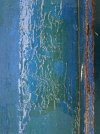
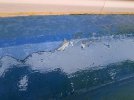
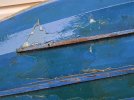
Depending on the condition of the paint and the type of brush on sealant, you may well (it could take some time) end up with a pealing mess that is even harder to deal with. Photos show varnish (?) over marine enamel after some years (on a skin on frame constructed "commando" boat a la DIY plans from "Popular Mechanics". I think the original owner/builder and/or relatives wanted to seal the boat to extend it's longevity. It now presents a challenge about to get that varnish off without harming the paint or canvas.
 

Attachments

  • image000000 (2).jpg
    image000000 (2).jpg
    212.4 KB · Views: 23
  • image000000 (1).jpg
    image000000 (1).jpg
    172.6 KB · Views: 23
  • image000000.jpg
    image000000.jpg
    206.4 KB · Views: 25
Last edited:
I am currently using a canoe that needs a new canvas. Mine is one color, without artwork. I plan to replace the canvas this winter. Meanwhile, I have taped and puttied obvious leaks and sponge out the water that finds its way in. Since only the bottom goes in the water, you might try some temporary repairs there. If you decide to paddle yours, be careful. Mine struck a stump this weekend and the old canvas tore easily.
 
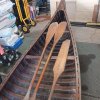
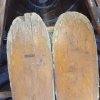
Addition photos, and information. I cannot find any identifying taggs or stampings anywhere on the canoe. Included in the sale were three paddles, which the son of the previous owner said have been in the family as long as the canoe (early 50's). Two are traditional beaver tail paddles, and the other is a longer, and narrower design. There is a legible decal on one of the beaver tail paddles [ARROW]. See photo.
The canoe has spent the past 75 years in central Minnesota (Minneapolis NW suburb Anoka). Where it may have came from before then, is anyones guess. It made many trips to the Boundry Waters Wilderness Area, local rivers, and lakes, and at least one successful moose hunt in Ontario Canada (the son said the family ate moose for a year)!
My original intent when purchasing, was to donate it to the Wisconsin Heritage Canoe Museum in Spooner WI, but it appears the future of that organization is in question (any updates on it's status would be appreciated). I have reached out to our local county museum, to see if there is any interest in displaying it. If not, I will display it proudly at the family cabin, and hopefully get to "gently" use it from time-to-time (her working days are through). Any educated guesses on origin, and approximate age are welcomed!
Sven
 

Attachments

  • canoe bow deck.jpg
    canoe bow deck.jpg
    220.9 KB · Views: 99
  • canoe bow strycture.jpg
    canoe bow strycture.jpg
    209.7 KB · Views: 95
  • canoe bow seat .jpg
    canoe bow seat .jpg
    308 KB · Views: 88
  • canoe bow logo.jpg
    canoe bow logo.jpg
    589.6 KB · Views: 72
  • canoe ribs, thwarts, and gun'ls.jpg
    canoe ribs, thwarts, and gun'ls.jpg
    272.8 KB · Views: 75
  • canoe stern deck.jpg
    canoe stern deck.jpg
    333.4 KB · Views: 71
  • canoe stern structure.jpg
    canoe stern structure.jpg
    246.2 KB · Views: 70
  • canoe paddles.jpg
    canoe paddles.jpg
    307.9 KB · Views: 64
  • canoe Arrow paddles.jpg
    canoe Arrow paddles.jpg
    212 KB · Views: 92
Sven, thanks for the additional images. Your canoe is unique in that it has splayed stems. These are often associated with Morris, however there are some Kennebec canoes that also featured these stems. It would be helpful to know if the stems are cedar.
If the stems appear to be hardwood, the canoe might be a Rhinelander. Possibly someone who has experience with these can comment. Given the location of the canoe, that is very possible.
 
Sven,
Nice canoe, not sure how I didn't see this, (I'm in Mounds View).
Not sure what to think about your comment about the WCHM, they seem active and busy on their FB site.
Dan
ps - I'd also go with Rhinelander.
 
  • Like
Reactions: MGC
Hey Dee Sven!
Just a couple of comments.
The seat is not original, not that that matters in this case.
It is probably a Rhinelander. They had a rounded end on the stem, similar to a beaver’s tail. Although the deck and narrow planks resemble my Rhinelander.
I have has issues with varnishing over a well prepared original varnish on a couple of occasions. Looked great until it warms up in the sun. That’s when the blisters appeared.
Your mileage may vary.
I’m a former board member at the Wisconsin Canoe Heritage Museum and was just there a couple weeks ago. I have not heard anything about problems there. Can you send me a Direct Message about what you’ve heard in that regard?
 
I agree with Dave, Dan and Mike. It looks Rhinelander to me. I thought the stem where it makes the turn upward (second and seventh photos) look like it is very thick and heavy not like a Morris which is the only other maker that used a flared stem. Other features also do not look like a Morris, seats, thwarts etc. so I'm going with Rhinelander. If it is a Kennebec with a Morris Stem there should be a serial number that could be looked up but I don't think it's a Kennebec.
Just my 2 cents worth and you may be over paying at that. Nice canoe though that would be real nice with some work.
 
  • Like
Reactions: MGC
The thread below has some pictures of other Rhinelander canoes and more details.

Benson


This is a very odd canoe, partly at least because it appears to have had significant modification. The stem sort of looks like hardwood (maybe) but its end isn't rounded the way a Rhinelander's is. It looks more like those of Morris and Kennebec. In areas it has keel screws at every rib like Morris, but in other areas not. Maybe replacement ribs? The ribs are tapered like a Morris or a Kennebec would have. At least some Rhineland's (I have seen very few) have un-tapered ribs. The thwarts look all wrong no matter what this is. The inwales appear to be un-tapered, which is unlike either Morris or Rhinelander. Also notice what appear to be fasteners in the tops of the ends of the inwales. Very odd. The tiny decks might be replacements. The seats are also strange - both hung from the gunwales and on cleats, plus the frame members are tiny.

Not sure how to say what this is but all things considered I wonder if it is a Morris-style Kennebec that has had a lot of work done to it, and that work obscures a lot of the original features. If it's a Kennebec with Morris style stem, it may have some replaced ribs, and replaced inwales, seats, decks, thwarts and maybe more, all done long ago so it all now has an aged appearance.
 
  • Like
Reactions: MGC
In picture 3, the seat appears to have been caned previously... the holes are partially visible beneath the current seat fabric.
Good eye Paul. Yes, the seats were originally caned, and "repaired" at some point with canvas impregnated with some type of resin. They don't appear to be porus, which would lead to a severe case of swamp @$$ on a long wet paddle.
 
  • Haha
Reactions: MGC
Hey Dee Sven!
Just a couple of comments.
The seat is not original, not that that matters in this case.
It is probably a Rhinelander. They had a rounded end on the stem, similar to a beaver’s tail. Although the deck and narrow planks resemble my Rhinelander.
I have has issues with varnishing over a well prepared original varnish on a couple of occasions. Looked great until it warms up in the sun. That’s when the blisters appeared.
Your mileage may vary.
I’m a former board member at the Wisconsin Canoe Heritage Museum and was just there a couple weeks ago. I have not heard anything about problems there. Can you send me a Direct Message about what you’ve heard in that regard?
Dave,
I haven't heard anything official. I live within 20 miles of the museum, and have stopped by twice in the past month, and it's been closed. Their phone recording is from last fall, stating that they will reopen in May. I have attempted to contact them, with no reply (email, text, and voice messages). I have gone as far as to contact the Spooner City Hall, and the Washburn County Tourism office, neither of which are aware of the museum's current status. The original members that I know/knew have aged out, or passed on, and I personally don't know any current members.
My intent isn't to start any rumors, but at the very least, it appears that "no one's minding the store".
I hope I'm wrong.
Sven
 
Everything at the WCHM seems perfectly fine. The museum is open today, opening in an hour, fact. Hours are Wednesday through Saturday 10AM to 4PM, Sundays and (open) holidays 11AM - 3PM. If you're in the area today, stop by and say hello!
 
Last edited:
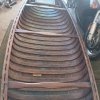
Thanks to all who have replied to this post. Based on the input from this group, and my limited research and knowledge, I concur that my canoe was most likely manufactured by the Rhinelander Boat Company. Following are some of my additional observations; The stems are a two piece design made of oak. The inner, and outer wales appear to also be made of oak (possibly ash, but I believe oak). The decks and seat frames are oak. The cedar ribs are tapered, with every other one fastened with a brass screw through the outer, and into the inner wales. The ribs are 2-1/8" wide with a 1-3/4" spacing at bottom center.
What is most perplexing to me is the skin material. I cannot determine if it has been "glassed" at some point, or if it's a heavy weight canvas. The weave is much coarser than canvas canoes I've seen (it's definately NOT dacron), yet it doesn't fray like fiberglas where it's been bumped and abraded. The adheassion is also very good, with no noticable blistering. The 68 year old son of the previous owner, could not recall his dad ever having it recovered, saying; "it has always looked like it does". So if it was recovered in fiberglas, it was pre 1960, and applied by a skilled craftsman (I have helped in the construction of a cedar strip kayak, and know the difficulty of getting fiberglas to lay smoothly over curved surfaces).
So my plans for this canoe are to re-seal the outer hull with a clear, pliable, satin finish product. I am not concerned with future pealing issues, as a total restoration is the next option, and one that I will not be undertaking (running short on life, money, and ambition). I will clean and oil the wooden surfaces, and may build a floor rack/slats to protect the ribs and hull when in use. Long term; I have eleven grandchildren, if any of them are interested in it I will pass it down to them. If not I will seek out and donate it to a museum for public display. My hope is that it can be maintained in its's current condition, and is never "restored". IMO restoration erases the visual history of of the boat, and makes them indishdinguishable from new, reproductions. I understand that for some badly deteriorated boats, full restoration is the only option. I don't feel this one is at that point... yet.
Thanks again to all who have read, and replied (or not). :)
Sven
 

Attachments

  • Canoe Bow Fabric.jpg
    Canoe Bow Fabric.jpg
    360.8 KB · Views: 12
Back
Top