
Paint, I’m never happy

chris pearson

Michigan Canoe Nut
Let’s beat that dead horse. I’m simply never happy with a paint job. I know I’m super critical and it’s just canvas and not a car, I get that, but the experiment continues. Epifanes is wonderful but too shiny, and even had them mix me up some semi gloss or satin, but no matter how much you mix it, it drys “streaky”. My local paint shop as well, goes on streaky. I love the low gloss of Kirby’s, perfect, but it doesn’t lay down, sorry George, I love ya! So there’s that.
Next problem, I paint and sand until all the pock marks disappear, but when I’m finished, I still see so much variation in the surface, I’ll include a critical shot of what I mean. I’ve been restoring since 1983 and still learn, and still never entirely happy. I’m all ears with the never ending pursuit of better quality. Oh, and now that I’m a so called pro, time is also a factor, no more endless fidgeting like I used to!!!!
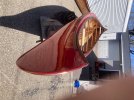
 

Attachments

  • IMG_9704.jpeg
    IMG_9704.jpeg
    328.9 KB · Views: 64
Most of us would be thrilled with a paint job that good, but a calibrated eyeball offers no mercy.
What makes you good, also makes you hyper critical. It's a slippery slope without end. I still find myself looking at things as though I am measuring in microns. Once you tune those instincts, there is no turning back.
 
Most of us would be thrilled with a paint job that good, but a calibrated eyeball offers no mercy.
What makes you good, also makes you hyper critical. It's a slippery slope without end. I still find myself looking at things as though I am measuring in microns. Once you tune those instincts, there is no turning back.
42 years industrial model maker is a curse!
 
Setting the goal of perfection and comparing it to what can be achieved using a stiff hull like can be achieved with a thick fiberglass hull, a metal hull or a very thick wooden planked boat is a waste of time. A boat with thin wooden rib and plank hull is never going to be as microscopic smooth as those other hulls can be. Then compound that tiny bit of unevenness with a fabric covering that is going to move with every temperature change and you expect that surface to have a mirror finish? I don't think so.
Filling in all those unsightly low spots that you can see can get the finish remarkably smooth as your finishes are. But the surface of the paint is still not as level as a hard surface can be. Putting any pressure on the hull as you sand it is going to depress the sanding surface. A bit more pressure here a little less pressure there and the surface is smooth but not even enough to get a mirror finish.
Maybe with untold hours of sanding with untold built up layers of paint you can achieve a better finish but the labor cost will be huge and the durability of the finish will be questionable. Perfect has many different definitions. Pick the one that apples to a wood/canvas canoe.
Maybe I'm wrong or maybe I'm lazy after four or five coats of paint but thats how I see it.
 
Rushton's Indian Girls (if the catalogs can be believed) had two coats of special filler (recipe available), two coats of color, and one coat of best spar varnish on the exterior. The interior had one coat of linseed oil and two coats of best spar varnish.

If you are doing more than that, you are overdoing it!

Of course, they still had the good stuff back then - white lead in filler and paint.

There is always Rustoleum. :eek:
 
My 2 cents.

Chris, having seen your work in person you are not just a canoe restorer, you are an artist. A good point Rollin alludes to is that these are not static displays (in my mind), these restored canoes are to be used as designed, built, and enjoyed. I cant imagine the conversations the original builders would be having seeing one or any or your works, they would be amazed!

Take joy in knowing you have brought them back better than original and whomever inherits them will enjoy and respect your work.
 
Your problem lies in preparation, almost entirely. Buy a new corn broom for each job, stop trying to economize. Oh and step back farther, and/or remove your glasses.
 
Oh and step back farther, and/or remove your glasses.
This was a lesson I learned many years ago. I had spent most of a summer restoring a Healey. I had done the best job of my life on the body work. Sitting on a tackle box, I pulled the stripped car into my buddy's body shop to have it painted. He looked it over. He didn't say a word. He looked at it some more, then Danny said "Mike, close your eyes and let me hold your hand." Danny was a man's man with an impressive stash, this was not a move, so I gave him my hand. He placed it on a fender and slid it along while telling me to "feel" what my hand was touching. I felt ripples and roughness that my eyes had not seen. It was not jump out at you hideous, but it was there, subtle, crappy. I stepped back from the car. Danny asked me, "how close to the car do you want to stand for it to look really good"? Ouch. That really hurt. Then he suggested that he prep it for paint. I had no choice but to agree. A Ford pickup truck orange...when he was done, it was a beauty.
Now, when I am painting a canoe, I sometimes think about that Healey, Danny and how close to the boat I want it to look good. In that most of my canoes are for paddling, not display, I go for a 20-foot paint job and call it a day.
 
Wooden canoes are evolving from the functional to the artwork category (especially with display models) so I fully understand your concerns about getting an outstanding looking finish. The link below may offer some perspective by showing seven examples where Old Town canoes had peeling paint issues. Struggles with paint are not a new problem.

Benson


Last edited:
Guys, thanks for the kind words. I understand it’s not gunna be a car finish and the problem I have isn’t rolling and tipping vs spraying, it’s the rolling micro hills after blocking. I think Rollin hit the head, it’s canvas and doesn’t like pressure and when free, it relaxes to show variation. But dammit Rollin, I look at your boats with a critical eye and you do a better job!!!
 
I'm going to have to agree with Chris about Rollins paint. Only once I've had someone else paint one of mine and I was shocked to see that he somehow did a damned perfect job with paint I can't ever get to flow, Kirby. He's got some kind of magic in that shop.
 
I'm going to have to agree with Chris about Rollins paint. Only once I've had someone else paint one of mine and I was shocked to see that he somehow did a damned perfect job with paint I can't ever get to flow, Kirby. He's got some kind of magic in that shop.
Mike. I think Rollin is an alchemist!!!!!!!
 
Please define "museum quality."
Haha. Probably a poor choice of words because I suppose 'museum quality' can apply to items in all stages of preservation- or decay!

I guess I meant a flawless finish: you know, the kind of finish on your canoe with which you would hate to actually make contact with a rock or portage landing... Maybe it's a cop out, but I'm content with a thorough finish with appropriate filler, primer, and color coats. I have been known to paint a couple extra coats to get a better finish, but of course that adds weight for those of us who actually portage these canoes!
 
I applaud your discontent Chris. I think if you really want to see how good your boats are, just set it next to one of mine. Keep up the scrutiny. It's perfectly fine. Actually, I want to be like you when I grow up.
 
Last month I painted with Kirby's Blind green. We all know how it comes out. I've been using Kirby's for 20 years. Well it came out like Epifanes , NO brush marks. Trouble is I didn't do anything different than usual. Maybe a little more of his thinner. :( Wish I new what I did.
I always ask the customer what he's using the canoe for and try and tell them about paint options $$$
Usually three coats canvas filler. One coat primer and 3 maybe 4 coats of paint at the most. Oh, and if you haven't had carpal tunnel surgery yet your not sanding enough. :)
 
Back
Top