Jossi
Curious about Wooden Canoes
Hello all,
I’m hoping the Peterborough experts here might enjoy having a crack at a canoe identification mystery.
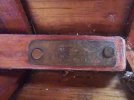
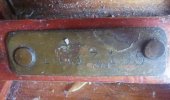
I have a 14-foot wood-and-canvas canoe with a brass plate that clearly reads:
1483 / 105
For the purposes of this question, I’m confident in that reading of the plate — I’m not trying to decipher an ambiguous 3, 8, etc.
The canoe measures approximately:
I’ve been trying to establish whether 1483 is actually a Peterborough Canoe Company model number, rather than assuming that it is simply because it looks like one.
From what I’ve been able to establish, Peterborough changed from its earlier one-, two- and three-digit model numbers to four-digit model numbers around 1939–41. The commonly available Peterborough model lists, however, appear to have a conspicuous gap between 1479 and 1488.
That made 1483 particularly interesting.
I then found Dick Persson’s posts here explaining that 1487 was indeed a Peterborough Auto Boat model number, one of several four-digit Auto Boat numbers used after 1939. I’ve also looked at a digitized 1939 Peterborough catalogue showing the earlier 12-foot Auto Boat No. 12.
That raises a question I haven’t been able to answer:
Does anyone have catalogue, price-list, dealer-list or other primary-source material identifying Peterborough models 1480–1487 — and specifically 1483?
I’m especially interested in whether this block represented four-digit redesignations of earlier models around the 1939–41 numbering change, possibly spanning different types of watercraft rather than forming a simple consecutive series of canoe models.
I understand that Peterborough’s second number was a serial/work-order number and that those sequences were periodically restarted, so I’m treating 105 as the work-order number, not as a useful model identifier.
I’m also deliberately keeping Canadian Canoe Company / Canadian Watercraft / Chestnut possibilities open. I don’t want to turn “1483 looks like a Peterborough number” into a Peterborough identification without evidence.
If anyone has access to the Peterborough catalogue collection — particularly material from 1939–1941, old price lists, dealer sheets, or anything showing the transition from the earlier numbering system to the four-digit system — I would be extremely grateful if you could check 1483.
And if 1483 rings a bell with anyone immediately, I would love to know what I’ve got!
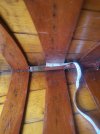
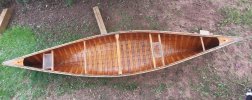
I can post detailed photographs of the canoe, brass plate, stems, ribs/planking, decks, seats and overall hull profile.
Thanks very much,
Joss
Nova Scotia
I’m hoping the Peterborough experts here might enjoy having a crack at a canoe identification mystery.
I have a 14-foot wood-and-canvas canoe with a brass plate that clearly reads:
1483 / 105
For the purposes of this question, I’m confident in that reading of the plate — I’m not trying to decipher an ambiguous 3, 8, etc.
The canoe measures approximately:
- Length: 14’
- Beam: 34½”
- Depth: 15”
- Weight: approximately 64 lb
- Ribs: 26
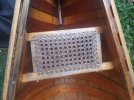
- Hand-caned seats
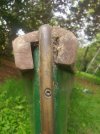
- Metal stem band
- Wood-and-canvas construction
I’ve been trying to establish whether 1483 is actually a Peterborough Canoe Company model number, rather than assuming that it is simply because it looks like one.
From what I’ve been able to establish, Peterborough changed from its earlier one-, two- and three-digit model numbers to four-digit model numbers around 1939–41. The commonly available Peterborough model lists, however, appear to have a conspicuous gap between 1479 and 1488.
That made 1483 particularly interesting.
I then found Dick Persson’s posts here explaining that 1487 was indeed a Peterborough Auto Boat model number, one of several four-digit Auto Boat numbers used after 1939. I’ve also looked at a digitized 1939 Peterborough catalogue showing the earlier 12-foot Auto Boat No. 12.
That raises a question I haven’t been able to answer:
Does anyone have catalogue, price-list, dealer-list or other primary-source material identifying Peterborough models 1480–1487 — and specifically 1483?
I’m especially interested in whether this block represented four-digit redesignations of earlier models around the 1939–41 numbering change, possibly spanning different types of watercraft rather than forming a simple consecutive series of canoe models.
I understand that Peterborough’s second number was a serial/work-order number and that those sequences were periodically restarted, so I’m treating 105 as the work-order number, not as a useful model identifier.
I’m also deliberately keeping Canadian Canoe Company / Canadian Watercraft / Chestnut possibilities open. I don’t want to turn “1483 looks like a Peterborough number” into a Peterborough identification without evidence.
If anyone has access to the Peterborough catalogue collection — particularly material from 1939–1941, old price lists, dealer sheets, or anything showing the transition from the earlier numbering system to the four-digit system — I would be extremely grateful if you could check 1483.
And if 1483 rings a bell with anyone immediately, I would love to know what I’ve got!
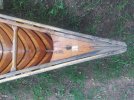
I can post detailed photographs of the canoe, brass plate, stems, ribs/planking, decks, seats and overall hull profile.
Thanks very much,
Joss
Nova Scotia
Attachments
-
 IMG_20260816_182414_Original.jpeg324.1 KB · Views: 124
 -
 IMG_20260817_134641_Original.jpeg299 KB · Views: 117
 -
 IMG_20260817_164135_Original.jpeg354.6 KB · Views: 104
 -
 IMG_20260817_133500_Original.jpeg265.9 KB · Views: 94
 -
 IMG_20260817_133247_Original.jpeg390.3 KB · Views: 97
 -
 IMG_20260817_133223_Original.jpeg530.5 KB · Views: 102
 -
 IMG_20260817_133439_Original.jpeg650.1 KB · Views: 108
 -
 IMG_20260817_133321_Original.jpeg369 KB · Views: 132