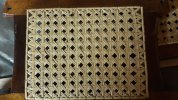
Artificial cane for seats

patrick corry

solo canoeist
Has anyone ever used artificial cane? I'm curious about its appearance and longevity. I'm currently caning four new seat frames and doing some mild cursing and teeth gnashing over defects in the cane I have. I actually like caning and wonder if artificial cane isn't too obviously man-made would it streamline the process?

Here, I'm midway through the 5th step of 7 step caning.
IMG_3189.jpeg
 
There are people who like the artificial cane, but I hate it. It looks like what it is, not like real cane. Actual cane does vary in quality, both among and within batches. Getting cane from a reputable supplier (like H.H. Perkins), and choosing good strands from your bundle will help. Epxerience makes a HUGE difference too. When new to caning, it can be very frustrating but the more practice one has, the better and less frustrating the process is.

Based on where you stopped, I'm guessing your frustrations mounted when weaving the diagonals. This is where it begins to get more challenging and where experience makes it easier and better. But here's some concrete, practical advice for you:

Pull out those diagonals and weave them the opposite way! That is, at every intersection with the vertical and horizon strands, you have the diagonal going over the top strand and under the bottom one. Do it the opposite - under the top one and over the bottom. It seems counterintuitive because you might think your diagonals will slip all the way inside the pairs of vertical/horizontal, but they won't. There will be much less strain on your diagonals, they will pull easier, and they will look much better in the end. You might need to zoom in on the photo below, but compare this with your pattern:

*GRACE_Carleton_seats_after.jpg
 
Last edited:
I found the plastic cane to be very stretchy & caused the seat to sag when sat upon. Not comfortable. Plus I imagine that it'd sag more with hotter weather.
 
I'm guessing your frustrations mounted when weaving the diagonals.
As I suspected, the artificial material is to be avoided. As a traditionalist in most things, I probably knew this internally but wanted to hear opinions.

Actually, I stopped where an individual cane finished (and it was time to set the table for dinner!), not out of frustration. I have finished that seat with both diagonals but I'm going to try your suggestion for the next one. Hopefully only I will notice the difference once in the canoe! This is my fourth seat so far using this pattern, and perhaps by dumb luck the others were woven in the correct direction. I did wonder while pulling the cane why it was more difficult than I remembered. Another thing I should do is reserve the really long canes only for the first four steps which don't require much 'weaving'. Doing this only once a year is perhaps a poor way to become proficient.

Two of my seats were the Chestnut pattern and seemed much easier, and I now notice the diagonals pass under the 'lower' canes and over 'upper' canes- likely making for easier passage of the diagonal canes!
67563339729__549D4727-AB81-4F9A-B721-95B99630B83D.jpeg


Many thanks for the suggestions.
 
Now that I'm reviewing my current seat.... I looked back at one I did for a new seat frame on my solo-rigged Island Falls Willow canoe. I photographed a hitchhiker while paddling in the Adirondacks and the picture does illustrate the "under the lower, over the upper" process for diagonals- if I'm seeing it correctly. I recall that this seat was an easy one, though part of that is surely the fact that the hole spacing was 7/8" rather than the 3/4" for my current seat. It's good to know one more detail; you learn something every day!
IMG_8185.jpeg
 
I never liked caning. Only did it because I couldn't find anyone to do it. It is not too bad if done while watching TV.
 
Both my seats blew out after about a year with artificial. Seems like the sun degraded the cane, it bleached out even though the boat was not used a ton.
 
I used it once and didn't like it, mainly because I left the pieces too long and they were a pain to weave. i should have cut them short like real cain.
They also came out very tight, I have no idea how long it lasted as I sold the canoe.

This said, I HATE weaving cain in seats, to the extent that the last set I had a friend do for me.
I don't mind installing prewoven cain but not hand woven.

Note, I'm also not a fan of making paddles either.

Dan
 
It's funny this "different strokes" thing. Like Howie, I love caning, but it has to be traditional strand-by-strand weaving. I'm the opposite of Dan (above) - I hate pre-woven cane. It can be a terrible pain to get the old spline out and the groove cleaned out (though lately I've gotten some great tools specifically for these tasks), plus I used to have real trouble getting new cane in straight, square with the frame. I've gotten much better at that, but the frustration of even a hair out of alignment used to drive me nuts, and still lingers in my memory.

Traditional caning is tedious but now after caning so often, I literally think I could do it with my eyes closed. And I enjoy that the final result is very satisfying.
 
Last edited:
It's funny this "different strokes" thing. Like Howie, I love caning, but it has to be traditional strand-by-strand weaving. I'm the opposite of Dan (above) - I hate pre-woven cane. It can be a terrible pain to get the old spline out and the groove cleaned out (though lately I've gotten some great tools specifically for these tasks), plus I used to have real trouble getting new cane in straight, square with the frame. I've gotten much better at that, but the frustration of even a hair out of alignment used to drive me nuts, and still lingers in my memory.

Traditional caning is tedious but I literally think I could do it with my eyes closed. And I enjoy that the final result is very satisfying.
Michael, I hate prewoven as well. As far as getting the spline out, boiling hot water and/or steam works wonders!!!
 
Well, since we're on the subject... I'll pontificate on seat caning. Again.. Specifically, why every canoe I've ever seen with hand-caned cane has done it wrong. I'm not referring to the caning process itself but in the manufacturer's placement of the holes for the cane. Every seat I've ever seen used a constant distance between these holes (usually 3/4", though I use 20cm or 0.787" 'cause it's easier to measure with a metric ruler). I contend that the seat would look much better if the holes at the corners were spaced not at 3/4" or 20mm but at some closer distance.

To see what I mean have a look at Patric's (nicely woven) seat below. See how the pattern is different at the edges? That's certainly not Patric's fault - he had to use the holes that were in the seat. The problem lies with the position of these holes.
1768741537478.png

Note that every diagonal crosses the horizontal & vertical strands at a distance halfway between the holes in the wood. To keep this pattern at the edges of the seat simply drill the corner holes at a different position. See the black circles I added to the pic below. If the holes were drilled at these locations the resulting pattern would look perfect - like machine made cane.
1768743610011.png

Practically speaking, drilling these corner holes at 3/8" instead on 3/4" might make diagonal strands at the edges a little difficult to weave, so I drill them at 7/16".

Obviously this can only be done if you build your own seats. But that's what I often end up doing anyway. The example shown below shows what I think a seat should look like - although this one was woven in a different pattern.
1768744282174.jpeg
 

Attachments

  • 1768744248055.jpeg
    1768744248055.jpeg
    191.3 KB · Views: 23
Pre-woven cane is (I think) horrible. Like Michael, I obsess over how hard it is to perfectly true it up. It can be maddening. On modern canoes, I generally toss the old seats and install new ones from Essex. I think my time is worth more to me than the few extra dollars of cost to put in replacements. Of course, I would never use the Essex seats in a good wooden canoe.
Hm...Howie posted while I was typing and I will add, Howie has chided me about the way I drill the holes in the seats I make. Next time I make seats, I'll listen to him. I don't want him to get cranky.
 
Must kiss the cow on this one, an aesthetic choice for me. Howie's technique is so neat ,clean and very pleasing to the eye. What I am missing is the framing of the work with the wider , obvious spacing that you get with the resulting border on all sides. The effect is more pronounced with a mahogany seat as the varnished seat underneath increases the contrast to the cane. You see this at work in oriental rugs, cabinetry, mosaics all sorts of artistic works. But it's not for everyone and that's fine.
Dave
 
I'll tell you what frustrates me most when caning seats with non equal hole spacing: sometimes two holes on one side or the other are NOT equally spaced. Again using Patric's seat as an example, see how the rightmost row holes are spaced further away than the holes on the other three sides. This drives me nuts! And not only because of the additional non symetry because often I'll find myself changing my weave pattern without knowing it. Grrr....
1768828523943.png


And by the way, my hats off to you guys that can use machine made care well. Whenever I've done it I find the pattern shifting to one or the other or both! as well as twisting. Not to mention sagging.
 
The expression "kiss the cow" typically refers to a Wellerism: " 'Everybody to their taste,' said the old lady as she kissed the cow," meaning different things appeal to different people, highlighting quirky preferences.

had to look that one up; Dave, never have i had an interaction with you wherein i learnt nothing.... lol
 
Back
Top