1901 homebuilt restoration

kerryb

Curious about Wooden Canoes
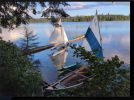
I bought this canoe 48 years ago because a friend needed money, & I wanted a fishing boat for the canal. The verbal heresay is the boat came from Muskoka Ca. and was made in 1901. It had been covered in polyetser fiberglass which came off surprisingly easily. There are no marks to indicate year or builder, we assume it is homemade. My current fantasy is to restore it as a decked sailing canoe. The question is how much grief would I get if the new finish was bright fiberglass (clear) instead of painted canvas? I’m just starting this journey, so the only pics so far are the boats that I already have
 

Attachments

  • IMG_0803.png
    IMG_0803.png
    2 MB · Views: 62
I own a formerly wood canvas canoe that was fiberglassed. The clear glass and varnish disguise the warped planks better than paint, and keep the boat light and tight. It was never a museum piece, it was saved from a burn pile by fiberglass. Maybe someday I will strip the glass and canvas it, but the work and cost will exceed its value.
 
If you do fiberglass it, use epoxy resin this time. Clear resin can be used, but it is much more vulnerable to UV damage, which will eventually destroy the varnish and eventually, the resin. A couple coats of decent paint will stop UV at the surface and is a much more practical way to finish the job. One thing to know is that any spaces between planks will need to be blocked or filled before glassing. Otherwise, the resin will drain through the cracks as you apply it, leaving what looks like screen wire over those spaces. Trying to fix that after it hardens is really difficult. On one boat, Norm Sims and I used essentially black body putty in the plank gaps before glassing the hull. Something water-based which could be washed out later might also work as a temporary filler.

This is my 1972 Guide Special that I special ordered keelless/canvas covered. About a year later the canvas split vertically on one side near the middle. It had been torn at the factory and somebody patched it with some sort of putty and sent it out as a brand new first quality boat. Warranty said that the buyer had to pay shipping both ways to send it back for repair, and that wasn't going to happen, so I bought canvas and filler. There was no forum back then and the "official" Old Town recanvasing instructions just said "Stretch canvas until tight all around." That was all it said.

After fooling around for a whole day, I still had some wrinkles. I filled it, but it looked pretty bad. I eventually took it off and the hull hung naked in the garage for many years while I worked on other stuff. When I did decide to get it back in the water, I decided to fiberglass it, which was something I had plenty of experience with from building strippers. It is WEST Epoxy with 6 oz fiberglass - having a full layer over a second layer on just the bottom and about four layers over the stems and painted with enamel. So, it can be done, but parts of the process can be tricky and it's probably not a good first fiberglassing project.

 

Attachments

  • guide2z.jpg
    guide2z.jpg
    224.3 KB · Views: 26
  • khtf 009 copy.jpg
    khtf 009 copy.jpg
    215.8 KB · Views: 26
If you are referring to sail rigged canoe, it appears to be a Stowe Mansfield. You removed that glass from that?
 
Thank you for your reply, I’m exploring this method to keep it light for my smaller stature. I also think the look will be neat too.
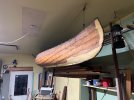
MGC, the stowe canoe is my current ride. I just got a Grumman lateen sail on it this year, but it is being retired in favor of a lighter boat. The canoe in question is hanging in my garage with heart-shaped decks, and no skin at the moment. Pictures soon.
 
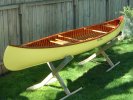
Old Peterborough or Chestnut, not 1901 but much newer. FWIW thats about the worst way to hang a boat, turn it over and put slings under it. Lots of stress on the decks, and not good for maintaining the hull shape end to end. After covering it will be even heavier. Wont really lend itself to decks, sail it open and consider a rigging deck rather than a mast thwart, it will sail much better.
 
OMG! Like MGC, I tried to magnify the canoe in the only photo in the post that says "I bought this canoe..." (and still couldn't see it well). It looked like a Stowe which is a fiberglass canoe! Wanted to respond but just didn't know what to say about you having removed the fiberglass from this one!

So now the one in the more recent photo; this one makes more sense. Like Andre said, much newer than 1901. As is often said here, "It's your canoe so do what you want," but if it were mine I'd canvas it. Better feel, no nasty epoxy, easier to restore in the future, etc. But this doesn't look like a particularly rare canoe, so no deep societal harm if it gets covered in goo and glass.
 
Oh Andre, you are such a spoil sport. Nothing improves a good old canoe more than some substantial deck hardware for hanging. After the canoe is hung from the decks it should be filled with stuff. Heavy cool stuff. I fancy finding a nice old pre-fire filled with muskrat traps.
WRT re-glassing it, it's been said but it is your canoe to do with as you please. Having said that, have you ever sailed or paddled a wood and canvas canoe? As Michael notes, they have a better "feel" and until you have experienced that, it is a bit hard to explain. I have owned a number of canoes that came to me covered with glass. It was a popular "fix" in the 60's. I paddled these while they were still glassed and then later after I had canvased them. What a difference.
A canoe I once owned had been a fixture at a Finger Lakes camp since the early 1900's. The family who owned it wrote about it in journals and took pictures of it along the way. The person from whom I got it had learned to paddle in it with his mother and grandmother. The grandmother had use it when she was a child and remembered it as it was. In the late 50's someone convinced her to have it glassed. She wrote about paddling it after it was done and complained about how it had changed, and not for the better. She wrote about how it had lost its feel. She used that canoe for over 60 years. If anyone knew, she did. Last year the canoe was restored to its original condition.
I confess to owning a few "modern" hulls, a Kevlar prospector, an Old Town Tripper, Camper and Penobscott.....Royalex hulls that serve as our "beaters". None of these are a joy to paddle, but if they fall off of the car, or get jammed in a power dam turbine (the Camper did) I'm not getting upset.
 
Yes Andre, I understand that is the worst way, because I just learned it days ago. After hanging that way for the last 26 years, it looks pretty good still, so a few more days will pass while I move other boats to make a proper cradle for it. After reading the latest comments, I shall research further an open sailing canoe, in canvas, because if it can’t sail, it won’t be first choice. I paddled this canoe for a couple years before stripping the glass off to see it’s real condition.
 

Attachments

  • IMG_1757.jpeg
    IMG_1757.jpeg
    386.8 KB · Views: 9
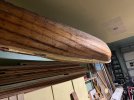
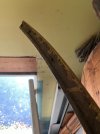
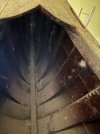
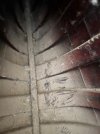
One of the identifiers of a pre-fire Chestnut is cant ribs the same width as the regular ribs. Do the ribs in this photo seam to qualify? The gunnels are said to be “closed”, does this return edge on the inside of the gunnel qualify for that description. I’m not worried about the value of my canoe, ( it’s a hobby) but it would be nice to guess who the manufacturer might have been.
 

Attachments

  • IMG_1766.jpeg
    IMG_1766.jpeg
    259.1 KB · Views: 11
  • IMG_1764.jpeg
    IMG_1764.jpeg
    314.6 KB · Views: 11
  • IMG_1763.jpeg
    IMG_1763.jpeg
    373.9 KB · Views: 11
Yours is an open gunwale canoe. The rib tips are sandwiched between the inwale and outward. On a closed gunwale canoe, the ribs are often (but not always) tapered to a feather edge at the top, and then a top cap and a side cap cover the tip and sides of the gunwale so that there are no open spaced left (hence "closed").

Open:
Grace_OT_wales.jpg


Closed:
Grace_Chamaeleon_after1.jpg
 
Last edited:
Back
Top