
Varnish and linseed oil order of operations

wstiles

Curious about Wooden Canoes
Hey folks,
A year after acquisition, and I'm closing in on finishing up the wood repairs (6 ribs, ~25' of planking, and new rails) on the 20' Maine homebuild I got off the side of the road.
It's not a show boat and will probably get urethane spar varnish since that seems to be what was on it.
My question is, do I oil the hull first or varnish the inside? Do I wait until after canvassing and filling to varnish?
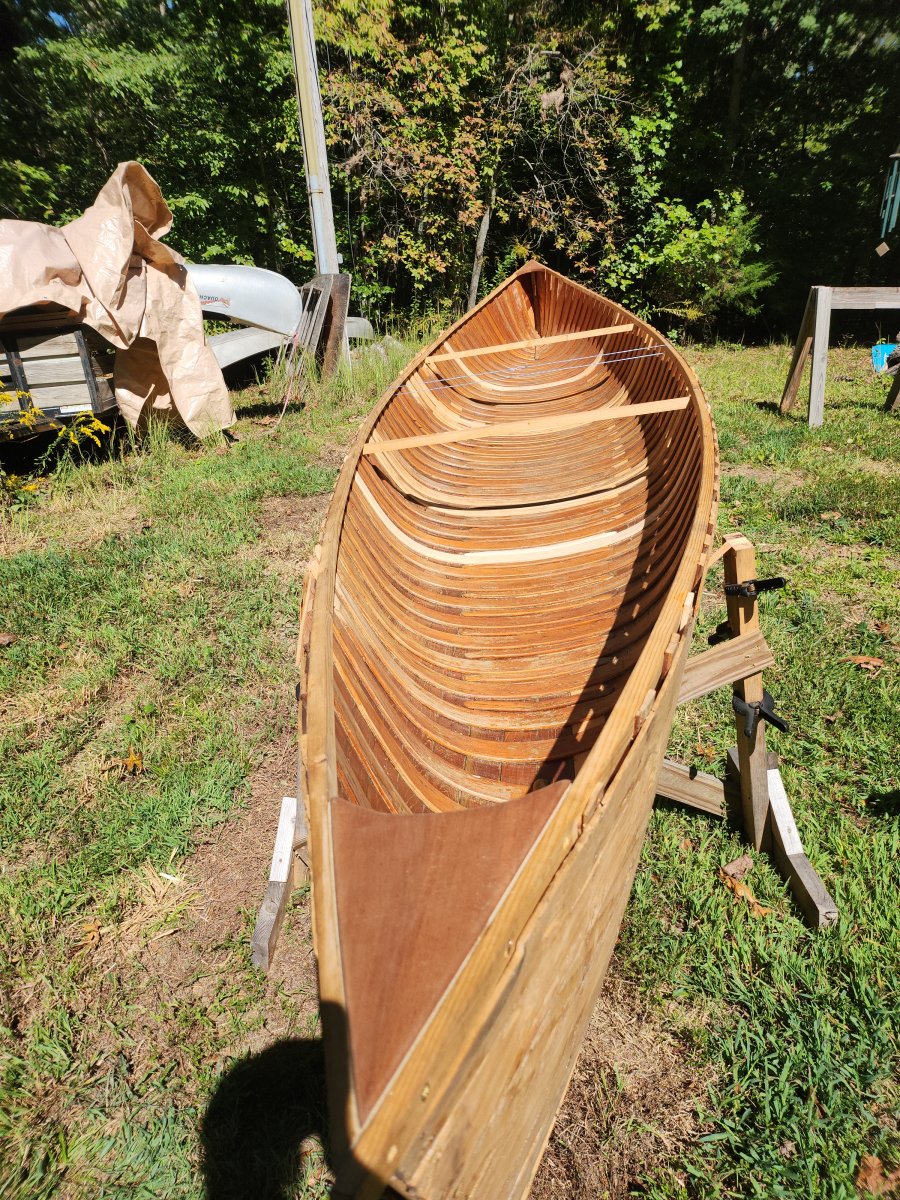
1000007378.jpg

Thanks for the advice. WCHA has been priceless in guiding my efforts.
 
I typically spar varnish the interior fully prior to canvas beginning with thinned coats. Additionally, although most commercial builders did not, I apply a wipe-on varnish (50/50 spar varnish/thinner) of the exterior prior to canvas. After canvas and paint, the only varnish necessary may be just touch ups and seasonal maintenance.
 
It's looking good!
But I think you should do a varnish test on a small piece of the wood used for the new ribs. If it is still a lot lighter in color, then maybe a light stain on those ribs before varnish.
I know you said it is not a show boat, but this small effort will make a big difference.
 
Thanks for the advice.
Dave, while the praises sung to Epiphanes within this forum make me a believer, I already have a supply of poly, and budget is a concern especially on a 20ft boat. I do wish it were otherwise.
Patrick, that sounds like a good plan.
Worth, staining the ribs is on the list. Fortunately what I have for the kitchen cabinets is a pretty close match to the original finish of the boat.
 
Hmmmm. I would not put that much work into a canoe and then use a polyurethane on it. In fact, I would never and never do use poly for any canoe work. You need to use a good quality marine spar. I also use only Epiphanes, but in a pinch I would use Captains. It's a bit thinner and a bit lighter in appearance, but a good quality product used by many.
Inside of the hull first to stop blead through, then the outside. blend in the new ribs before applying the first coats of thinned spar.
 
Boy, I think you will regret the Poly stuff. Maybe this 20 foota would indeed prefer shellac instead , respecting the budget , ease of redo, OK to go to paint later etc. I always raw oiled before canvas and outer hull oil ( boiled and not always necessary ) then fill, cure ( as the interior drys as well )
and varnish with Epi. I have always thought that whatever varnish went between the ribs onto the filled and cured canvas helped as an additional sealant on the canvas and the untreated underside of the ribs along the open rib joints. I have found too that when you vacuum the plank cracks to get to sand etc. out , the varnished surfaces there really come clean easily. Could be the TMI and too- anal disease. Whatever
Have fun.
Dave
 
Never use poly on a boat used outdoors.

A few years ago a member here who worked in the paint/varnish industry explanded why - I'll try to repeat it.

When poly fails, it cracks and exposes the wood to water/elements. To refinish it, it has to be completely removed.

Varnish fails by oxidation on the outer layer, and it just needs to be sanded to be refinished. The wood remains protected.

Dan

ps, I like the old Interlux Schooner(?) varnish, it goes on well and smells so good. :)

I would never and never do use poly for any canoe work. You need to use a good quality marine spar. I
 
Back
Top