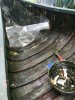
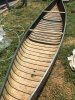
My first project- time to strip out the old varnish?

This is an interesting thread...it's been on quite a journey to end up here.

If it were me, once I had myself convinced that all of the varnish has been removed, I would give it a wash with TSP. Be sure to rinse it well and then let it dry.
The wash will give you a better picture of how well you have done with the stripper and it will also help to remove some of the residual gunk that would otherwise need to be removed with the Teak cleaner..
After washing with TSP and if you are convinced that the varnish is adequately removed, follow with a cleaning with Teak Nu. Be sure to keep things wet and not get the order reversed or you'll cause extra work for yourself trying to get the wood the same color throughout.
The Teak Nu should get you to a point where you can begin sanding the hull.

At the stage you are at (varnish removal) I have had pretty good luck using soft (very soft) brushes to pull up the varnish that tends to get into the grain and in corners. I apply the stripper and then follow with a brush. Then I use the scraper to lift the clumps that loosen up. Brushing at this stage will save you some steps later when you TSP and Teak Nu since it will loosen what might otherwise be hard to get off.
Be very careful with (scrapers) the brushes you use for varnish, TSP and Teak Nu. Brushes can really dig into the soft cedar if you work them too hard.
 
Thank you MGC
Is there a UK equivalent to TSP I can't seem to find mention of it. I did see a thread where someone recommended dishwasher cleaner has anyone tried that?
Many Thanks
Alick
 
Thank you MGC
Is there a UK equivalent to TSP I can't seem to find mention of it. I did see a thread where someone recommended dishwasher cleaner has anyone tried that?
Many Thanks
Alick

Hm...I am not at all familiar with what is equivalent or available in the UK.... Possibly Trisodium Phospate (TSP) is not available due to environmental concerns? It is available here in the US. There are also phosphate free versions available here. They work less effectively but they do work.

Dish-washing detergents (in the US) once contained a high amount (7%) of phosphates so I can understand the potential this may have had as an alternative. I am not sure if phosphates are an ingredient in the UK....possibly in Western Europe...non-EU or possibly in the UK in a few years, post-EU;)

I often find myself wishing that this site required it's members to list their location instead of allowing it to be an optional entry.
 
Hi, Alick....I have never used/needed TSP after stripping. I am very patient with the stripper and use my little power washer with an adjustable stream, when I find, sampling here and there , that the stripper has really done its work. There are times when I will drag a putty knife over the ribs only to make sure we are getting to all the layers. And I do use a fairly stiff scrub brush on the stripper after it appears to have done its work, then wash her out. This works well on the rib edges, all areas up near the inwales and especially up under the decks where spraying is difficult.
I then almost always go to a 2 part product called Snappy Teak and usually the hull looks brand new. I really think good stripping work is as much an art as anything else...........but for me patience and persistence goes a long way toward getting the best results. You will always find spots where softened varnish has escaped your washing. Now is the time to get it off and out as it will harden up and be a real pain later when you are sanding prior to finishing or worse when you are using the Snappy T. and ready to finish this demanding job. Have fun ! Dave
 
Hi Alick - google tsp cleaner: you can get it. I'm thinking similar to sugar soap, but I'll find out in due course.

Sam
 
Hi Sam
Thanks for that it appears they sell it on amazon but it sounds like nasty stuff and they don't say what concentration to go with...
I have some sugar soap that I bought yrs ago and never used so may try that tomorrow however according to its data sheet it only contains 1% tsp which may or may not be good...
see also here http://www.doityourself.com/stry/best-ways-to-use-tsp-cleaner
Cheers
Alick
 
Last edited:
Hi Folks
One more thing is that I seem to have this white stuff near the stems that doesn't seem to come off.
Is it best just picked off with a chisel perhaps or am I better to leave it?
Is it perhaps white lead and highly poisonous?
Many Thanks
Alick 20161011_181807.jpg
 
I am on the eve of trying my first restore. If mine comes out half as beautiful as this I will be pleased. She is a lovely craft.

John Metts
 
I am on the eve of trying my first restore. If mine comes out half as beautiful as this I will be pleased. She is a lovely craft.

John Metts

John,

As the one who started this wandering thread a long while back, welcome. And I hope you enjoy working on your canoe as much as I did mine.

Tim
 
Sorry to resurrect an old thread, but would a heat gun and a scraper work to remove old varnish? Or is it much better to go with the chemicals discussed here?
 
Patrick,
Varnish doesn’t do well with the heat gun in my experience. It just gets gummy and hard to pick up with a scraper. I think chemical is the way to go.
I have a commercial furniture stripper remove varnish from my canoes, but finding one that will do canoes is difficult.
I have had decent success with this....
 

Attachments

  • image.jpg
    image.jpg
    164.9 KB · Views: 558
Plus with all of the intricate details in a canoe, you would be hard-pressed to get the old varnish out of all of the nooks and crannies. Chemical strippers do a great job of that.
 
Jim, Etal.,
I am currently using Ultra-Strip on the Rushton I'm working on. I got it from Jamestown Distributers. It does not melt your brain cells or burn your skin and it actually works! Not cheap however. Stripping a canoe sucks - there is no way around it. This Rushton has green paint on top of the old varnish. If I could get paint to stick to my barn as good as its stuck to the canoe I would be a happy guy. Put on the stripper, cover it with plastic sheet so it doesn't dry out so quick and wait. It is taking me at least two coats. Scrub it plastic bristle brush and scrubby pad with lots of water.
Jim C.IMG_4062A.JPG IMG_4062A.JPG IMG_4077A.JPG IMG_4095a.JPG IMG_4106a.JPG
 
One thing I found out about on this forum was the best tool I ever bought. The Dremel 6000 Contout Sander. They don't make them any more but I picked one up, complete with the case and various shape attachments for $20 on Facebook Marketplace. It's small, light and variable speed so you have a huge amount of control for precision work.

After the initial chemical stripping, this thing is a lifesaver to work from coarse to fine grit sandpaper til ready for varnish. Bonus: you'll still have your fingerprints when you are done with the job by avoiding sanding them off with manual sanding.

The only thing to note is that they don't sell the (overpriced) little sandpaper loops for it any more, so you need to cut strips out of sandpaper sheets to fit.
dremel.jpg
 
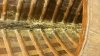
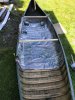
I am enjoying working on my first project canoe. I have it just about ready to strip out the old varnish. I could take it to have it done commercially but for two reasons I'm thinking I will just do it myself. One, there is so little varnish left on the thing I don't think it's going to be particularly difficult, and two- I just want to do it myself. I have very much enjoyed the hours I've spent on the canoe so far and I'm not at all concerned about the hours of time I'll spend working on it stripping.

I've done some searches and there are so many opinions on how to best accomplish this that I'm confused. Here are my questions. First, the canoe has a lot of just plain dirt in it. I've used a shop vac, then an air compressor and toothbrush along with a dental pick between the planks just picking off dried mud. I would like to use water to clean it before even attempting the stripping but I'm afraid the old wood with just soak up water and that perhaps this would be a bad idea?

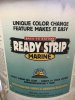
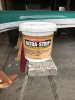
I'll probably just head to Home Depot to look for some kind of product to strip it with. I've seen a lot of suggestions on the forum but much of it needs to be special ordered. Anybody have something that worked well for them that can be purchased from someplace like Home Depot?

So my plan is to put down some plastic on the driveway, apply the stripper in small sections, after it has accomplished the job scrape it off with some type of plastic scraper and finish with a scrub pad (water mixed with TSP? Acetone?). Should I use water to try to clean it beforehand? Can I just use water to rinse it out afterwards?

Do I need a whole new plan? Thanks for any advice or help. View attachment 29028View attachment 29029
I am in the process of restoring a Chestnut and part was refinishing the interior. I detest using chemical strippers and having a history of using card scrappers, decided to scrape the old finish off. Had read in a post to make scrappers out of an old hand saw blade. I had an idea of the shapes needed. but figured I would need a plasma cutter. Fortunatly, I couldn't find a saw blade so grabbed an old Irwin pull saw and wondered if that would work. Pull saws have a very flexible blade. I knew one of the issues I would have is putting a burr on the edge. A straight edge is fairly simple. A radius not so easy. Cut the shapes with tin snips and noticed that one side had a burr. Where the planking fastens to the ribs was going to be the hard part as I didn't want to damage the planking scraping across grain while scraping the edge of the ribs. I cut the edge of the scrapper that would run along the planking from the other side. With the burr cut to the other side helped. Care still has to be taken but was not as likely to scrape across grain. At this point I'm about a third of the way done. I am very happy with the results so far. When the burr starts to wear I grab the tin snips and cut 1/16 off the edge and sharp again. I have an Old Town waiting to be restored and if I run out of room to cut new scrappers from the old saw blade, with the way this works, I will think nothing of cutting up a new saw. My issues with chemical strippers? I always worry about getting the wood clean. If all the stripper is not removed, will there be a reaction with the varnish? I usually clean the wood after stripping with copious amounts of acetone. This can raise the grain requiring more sanding. How do you clean between the planks? I like scrapping is a I get a close look at each plank and rib. If there is a split that needs to be pulled together and glued I don't have to worry about removing all the stripper to get a good glue surface and I don't have a pile of rags to get rid of. But being an old man I do have tired fingers.
 
Back
Top