Kathryn Klos
squirrel whisperer
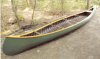
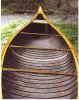
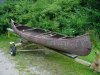
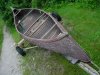
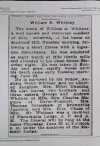
W.A. Whitney of Milo, Maine, sold canoes from the 1890s-1910. The canoe in these pictures was examined by Rollin Thurlow, who dated it to around 1895.
This canoe was recently sold through the classifieds in "Wooden Canoe". We didn't buy her, but contacted the seller for information out of curiosity. The seller very graciously sent us pictures and written information on the canoe, which may help identify others by this builder that aren't as clearly marked.
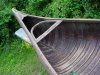
As with the early canoes of Gerrish and White, this canoe was built with rails which extend beyond the stems and elements that are mortised into the gunwales. It was originally a closed-gunwale canoe but was converted, in a restoration, to open wales.
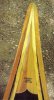
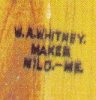
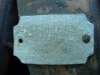
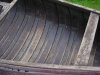
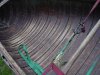
The canoe is 17 feet long, 33 1/2" wide, and 12" deep. Ribs are 2 3/8" and are tapered. Half ribs are 1 1/4" wide. Decks are 11 1/2" long, with "W.A. Whitney/Maker/Milo-- ME" on the bow deck.
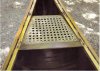
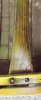
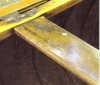
The single stern seat is mortised into the inside rail, as is the bow thwart. The remainder of the thwarts are bolted under the rail. In the pictures, these appear to be constructed of American chestnut-- a wood species used by Gerrish and other early builders. The canoe apparently has lashings on the deck tips, which aren't clearly seen in the pictures but are mentioned in Rollin's evaluation.
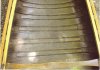
The half-ribs are interesting-- they exist only in the seating-areas, just as with an older Morris that was recently sold in Minnesota (the one that had been restored by Joe Seliga). Rollin felt the half ribs are original to the canoe. There are seven beneath the stern seat and seven in the place where the "sport" would place his comfortable canoe chair.
The canoe spent her life in Maine, on Sebec Lake.
I'll attach six of the pictures here and post the others after that.
This canoe was recently sold through the classifieds in "Wooden Canoe". We didn't buy her, but contacted the seller for information out of curiosity. The seller very graciously sent us pictures and written information on the canoe, which may help identify others by this builder that aren't as clearly marked.
As with the early canoes of Gerrish and White, this canoe was built with rails which extend beyond the stems and elements that are mortised into the gunwales. It was originally a closed-gunwale canoe but was converted, in a restoration, to open wales.
The canoe is 17 feet long, 33 1/2" wide, and 12" deep. Ribs are 2 3/8" and are tapered. Half ribs are 1 1/4" wide. Decks are 11 1/2" long, with "W.A. Whitney/Maker/Milo-- ME" on the bow deck.
The single stern seat is mortised into the inside rail, as is the bow thwart. The remainder of the thwarts are bolted under the rail. In the pictures, these appear to be constructed of American chestnut-- a wood species used by Gerrish and other early builders. The canoe apparently has lashings on the deck tips, which aren't clearly seen in the pictures but are mentioned in Rollin's evaluation.
The half-ribs are interesting-- they exist only in the seating-areas, just as with an older Morris that was recently sold in Minnesota (the one that had been restored by Joe Seliga). Rollin felt the half ribs are original to the canoe. There are seven beneath the stern seat and seven in the place where the "sport" would place his comfortable canoe chair.
The canoe spent her life in Maine, on Sebec Lake.
I'll attach six of the pictures here and post the others after that.