FlyingMoose
Big city & Back country
Hi wood-canvas hive mind,
Long time lurker, first time poster.
The tl;dr is this: I had what seemed like a lot of canvas damage from what seemed like a minor scrape with a rock, and I’m wondering if the culprit is my shellac bottom.
The long version:
I have a new-to-me 1982 18’ White Guide (originally built by Jerry Stelmok for Garrett and Alexandra Conover). According to the seller, it was recanvased ten years ago. Half-ribs. Shellac bottom (no paint below waterline). It’s heavy as hell, but a beautiful boat!
The other day, I took it out on a quick paddle on Belle Isle in Detroit, where I live, and I scraped against a submerged “rock” (chunk of concrete—this is Detroit, after all!). This was flatwater, and I wasn’t going particularly fast. I felt the scrape and heard the ugly sound of rock on canoe, but it seemed like nothing major. I figured I’d have some scratches on the shellac; no big deal—that’s what it’s there for, right?
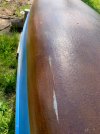
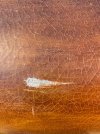
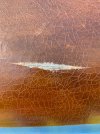
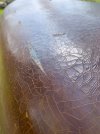
Wrong. I started taking on water immediately and had half an inch or more along the length of the boat by the time I finished paddling half an hour later. Turns out, the “rock” had scraped through to the canvas weave, splitting it in four places. (See pictures.)
Patch time. No big deal. Done it a million times (though always with Ambroid, which I have no more of—we’ll see how Duco cement holds up). Half an hour of snipping and glueing later, and I’ve got some decently faired patches over the tears. I’ll shellac over those tomorrow. No harm done.
So why am I posting? What bothers me is how easily the tears happened. I’ve been paddling wood-canvas boats since I was twelve; I’ve banged up a lot of boats on a lot of rocks, but nothing at all about this impact felt like anything more than a scratch to me until I started taking on water. I was genuinely shocked to see the damage once I got the boat to shore. The “rock” had gone through a pretty thick shellac crust and the filler (traditional, oil-silica stuff) to the weave of the canvas in four different spots. I haven’t taken this boat on a river trip yet, and now I worry that I shouldn’t, if it’s going to damage that easily. I do a lot of my trips in Ontario, where rocks are pretty hard to avoid entirely.
SO: is this a shellac bottom thing? I’ve slapped coats of shellac over paint for river trips before, but this is my first canoe with an all-shellac bottom. I thought the whole point of the shellac bottom was to be “slippery” over rocks, but this seemed more like “crumbly.” Has anyone else had this problem? (FYI: I refreshed the bottom with three coats of Zinsser shellac in November.)
Your collective wisdom is appreciated.
Long time lurker, first time poster.
The tl;dr is this: I had what seemed like a lot of canvas damage from what seemed like a minor scrape with a rock, and I’m wondering if the culprit is my shellac bottom.
The long version:
I have a new-to-me 1982 18’ White Guide (originally built by Jerry Stelmok for Garrett and Alexandra Conover). According to the seller, it was recanvased ten years ago. Half-ribs. Shellac bottom (no paint below waterline). It’s heavy as hell, but a beautiful boat!
The other day, I took it out on a quick paddle on Belle Isle in Detroit, where I live, and I scraped against a submerged “rock” (chunk of concrete—this is Detroit, after all!). This was flatwater, and I wasn’t going particularly fast. I felt the scrape and heard the ugly sound of rock on canoe, but it seemed like nothing major. I figured I’d have some scratches on the shellac; no big deal—that’s what it’s there for, right?
Wrong. I started taking on water immediately and had half an inch or more along the length of the boat by the time I finished paddling half an hour later. Turns out, the “rock” had scraped through to the canvas weave, splitting it in four places. (See pictures.)
Patch time. No big deal. Done it a million times (though always with Ambroid, which I have no more of—we’ll see how Duco cement holds up). Half an hour of snipping and glueing later, and I’ve got some decently faired patches over the tears. I’ll shellac over those tomorrow. No harm done.
So why am I posting? What bothers me is how easily the tears happened. I’ve been paddling wood-canvas boats since I was twelve; I’ve banged up a lot of boats on a lot of rocks, but nothing at all about this impact felt like anything more than a scratch to me until I started taking on water. I was genuinely shocked to see the damage once I got the boat to shore. The “rock” had gone through a pretty thick shellac crust and the filler (traditional, oil-silica stuff) to the weave of the canvas in four different spots. I haven’t taken this boat on a river trip yet, and now I worry that I shouldn’t, if it’s going to damage that easily. I do a lot of my trips in Ontario, where rocks are pretty hard to avoid entirely.
SO: is this a shellac bottom thing? I’ve slapped coats of shellac over paint for river trips before, but this is my first canoe with an all-shellac bottom. I thought the whole point of the shellac bottom was to be “slippery” over rocks, but this seemed more like “crumbly.” Has anyone else had this problem? (FYI: I refreshed the bottom with three coats of Zinsser shellac in November.)
Your collective wisdom is appreciated.