Conundrum

shelldrake

LOVES Wooden Canoes
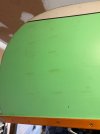
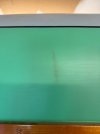
Good morning, About six years ago I built an Atkinson Traveler. The boat has been essentially unused since then and has hung inverted in an insulated garage. Recently I have been noticing the appearance of dark lines on the exterior paint which I'm quite sure correspond with the hidden plank butt joints. Upon closer inspection this morning, I'm also seeing the appearance of some hrizontal lines at plank seams. See attached photos.

The canoe was planked with quarter-sawn northern white cedar and ribbed with flat-sawn NWC. The interior was sealed with Interlux Schooner varnish thinned 40% with Interlux 333. A day later, the exterior was sealed with hot boiled linseed oil. Canvas(two weeks after linseed oil) was Rollin's treated 10 oz, filled with his filler. Primed with Interlux Pre-Kote(I think). Painted with Kirby's Light Gray and Light Green.

The lines do not wash off with soap and water and appear to be print-through of the linseed oil perhaps?

I spoke with Rollin about this this morning and he indicated that he had never encountered such a thing. Nor have I, although all of my previous restorations have either not had the exterior sealed, or I used thinned varnish, not linseed oil.

Any experience with such a thing among the Brain Trust?
 

Attachments

  • IMG_0976.jpeg
    IMG_0976.jpeg
    83 KB · Views: 36
  • IMG_0977_edited.jpg
    IMG_0977_edited.jpg
    76.1 KB · Views: 36
  • IMG_0507.jpg
    IMG_0507.jpg
    392.4 KB · Views: 36
Perhaps test with rubbing compound or even very fine sandpaper to see if the problem is only on the surface rather than through the entire canvas/filler/paint. If it's only on the surface, a good buffing could remove it. Linseed oil is often made a culprit with little or no evidence, but the culprit could be any number of things.

Butt ends of planks and joints between planks are different not only because they could hold more sealer, but also because they can be more open to air movement. This could lead to slightly increased condensation of water on the paint surface at those lines with weather changes. Also, garages are often full of chemical fumes, even if at a low level - fumes from the lumber, OSB, and sheetrock building components, and from stored chemicals. Any of these could be interacting with those open space in the planking. The point is that (1) switching to something other than linseed oil may not solve the problem, and (2) being kept in a closed space for years may have exposed the canoe to things it otherwise might not have been exposed to. [NOTE: I'm not a protector of linseed oil or anything else; just trying to think logically about the possible culprits.]

About chemicals in closed spaces, in a garage I once used, something degraded the urethane tires on everything there, degraded to the point of disintegration. These weren't a single batch; they came with a tables, they were on multiple batches of casters I ordered, and even the urethane tires on a bandsaw. I have no idea what caused it, but it happened only there. In another place (not on the coast, not near salt water), something caused rapid and dramatic rust on anything steel.

Bottom line - buffing might help in the short term, fresh paint might be required in the longer term, and getting more air circulation might solve the problem more generally.
 
I have encountered a similar situation. Not stains, but bumps from varnish that during hot/cold, moist/dry cycles had caused varnish to be squeezed out of the seams. The worst time, I tended to think it was because I varnished after canvas stretching where varnish seeped into the canvas. If you varnish after canvas, that could be the culprit.
 
Hmmmm. Well, I do have an old Jeep CJ7 parked under the canoe. It runs pretty rich...............

I also have an E.M White Guide hanging out there. I don't see any lines on it, but It has dark blue paint. It is also not hanging over the Jeep.
 
Long ago, I did not finish the interior before canvassing. Occasionally, either the stain or the varnish or both would affect the canvas and filler at the planking cracks. This appears to be a similar condition.
 
Long ago, I did not finish the interior before canvassing. Occasionally, either the stain or the varnish or both would affect the canvas and filler at the planking cracks. This appears to be a similar condition.
I checked my notes. I applied two sealer coats of thinned varnish to the interior prior to canvasing. Four coats of un-thinned varnish went on after canvassing. No stain. For sure, something, either the varnish, or the linseed oil I'm guessing is causing this.
 
Now that I can see the pictures, I would agree that it appears to be varnish. If coats of varnish are applied to the interior before the filler on the outside is completely cured, and it gets between the planking seams, it appears that the varnish can leak into the filler and soften it up and discolor the paint. I'm not sure of the science there but I just have witnessed the effect. It happened to me enough times that for many years I do just about all the interior varnishing before the canvasing and don't do any varnishing before the filler has completely cured, which for me is six weeks. I'll put on the last coat varnish some time latter.
Time will harden everything and then it can be repainted if the appearance is too distressing.

Unless- one more thought ... If the linseed oil on the outside of the hull was put on real heavy and the canvas put on before it had a chance to soak into the wood, maybe the oil soaked into the canvas and cause the same effect as the varnish would have. The oil or the varnish does pool up at the seams more that most other areas.
 
Strange things happen. This is a canoe I picked up a few years ago. I was pretty surprised to see the Douglas Plaid.
I tend to varnish the inside, let it sit for a while before applying my warm mix of turpentine, linseed oil and mineral spirits. Then I wait even longer before I canvas. I work at a snails pace most of the time.
1788913233536.jpeg
 
Back
Top