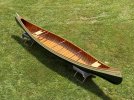
Brodbeck Progress

JClearwater

Wooden Canoes are in the Blood
I thought I might provide an update on my progress with the old Brodbeck I bought last Spring. I had started a thread a while ago with a couple pictures of the old girl trying to show the planking pattern for those who are interested in such things.

I am waiting for the filler to dry at the moment so I have time to compose this thread.

A very short, incomplete history of Brodbeck is as follows.

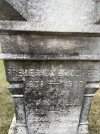
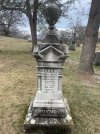
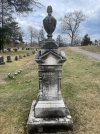
Frederick Brodbeck Jr. was born December 31,1869 in Dedham, MA. In the 1896 Boston City Directory and earlier ones he is listed as a “mathematical instrument maker” which I take to mean he was making rulers, drafting scales, protractors, slide rules, drafting compasses etc. He first advertised as a canoe builder in the Directory in 1897 but given the time required to compile the information for the directory he was likely building canoes in 1896. Who he learned the canoe business from is unknown but there were several canoe builders in the area at that time. In 1900 he was boarding with his widowed sister Emily, her daughter Anna and his uncle William Brodbeck, on Washington Street, West Roxbury, Massachusetts. He married Minnie L. Karcher in Dedham, MA in 1907. He and Minnie never had children. Frederick, working alone, built canoes in a small building behind the Dedham Boat Club. He was an early member of the club and a respected paddling coach and team captain for the club. There are numerous articles in the Boston Globe about canoe races spanning several years. He died May 12, 1930, at age 60.

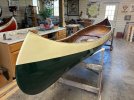
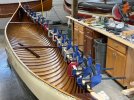
This canoe came to me in a rather sorry state. A previous owner had removed the canvas, the stem bands, the keel and eleven broken ribs. The gunwale caps and side caps and keel were missing. The inwales, because most of the rib tops were rotted off or broken, was completely separated from the canoe for over half the length. The stern stem was completely shot and the bow stem half rotten and warped. And just to top it off the canoe had sat outside covered with a tarp for at least a decade. Fortunately, several battens had been installed on the outside of the canoe, albeit with drywall screws, that held it in fair alignment. The inwales were in decent shape except for the ends at the stern which had rotted off. The mahogany thwarts and decks were in good shape. The seat frames, which appear to be made of Chestnut, were also in good shape. The center thwart, which was removable, was missing.

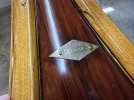
The unique things about this canoe and other early Brodbecks are as follows. Inwales extend past the stems. The rib tops are tapered unlike most other Charles River builders. The thwarts and seat frames are arched up similar to how thwarts are made on birchbark canoes and are uniquely shaped. The shear plank is feathered very thin on the top edge and does not extend up and over the outboard sides of the inwales. They actually stop short of the bottom of the inwale leaving a gap of between 1/4” and 3/8” that the canvas would span over. The backside of the canvas is visible from the inside of the canoe. And finally the seats are caned entirely different from the way we expect canoe seats to be done. (see picture).

After the interior was stripped the following wood repairs were made:

I replaced twelve full ribs, two cant ribs and did backside repairs on two others. I repaired or replaced the tops of nearly every rib. I replaced the entire stern stem and at least a foot of the bow stem. The tips of the inwales on the stern were replaced. I replaced nearly 50 feet of planking. I made a new center thwart. The new ribs and planking were stained and the varnish completed. The canvas was installed this past week and filler laid on. While that is drying I will cane the seats and start making new gunwale caps and keel.

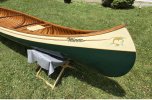
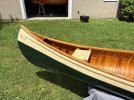
So that’s where I’m at. It’s been a long haul but the plan is to have it ready for the water by Assembly in July. We haven’t settled on a color yet or picked a name for the old girl so stay tuned for that.

Attached are pictures. I'll have to post a couple times to get them all on here.

Jim C.
 

Attachments

  • 1905 ACA Yearbooka.jpg
    1905 ACA Yearbooka.jpg
    86.7 KB · Views: 57
  • IMG_7188a.JPG
    IMG_7188a.JPG
    247.8 KB · Views: 60
  • IMG_7187a.JPG
    IMG_7187a.JPG
    192.3 KB · Views: 56
  • IMG_5808a.JPG
    IMG_5808a.JPG
    146.3 KB · Views: 53
  • IMG_3970a.jpg
    IMG_3970a.jpg
    145.4 KB · Views: 57
  • BrodbeckSeata.jpg
    BrodbeckSeata.jpg
    128.5 KB · Views: 62
Many thanks for posting this. Your progress is remarkable. I especially like that freshly varnished interior picture; did you stain fresh wood with oil based pigmented stain or aniline dye? And how did you rejuvenate the color in those lovely decks? Will you duplicate the seat weave?
 
Patrick,
Thanks for your kind words. I used Minwax oil based stains on the new ribs and planking after I put a few test patches of varnish on the old wood. That way I knew what to aim for with staining the new wood. There is no stain on the old wood. The decks are Mahogany. I used Minwax English Chestnut stain. Some people don't like how dark it turns out but I love it. My plan is to duplicate the seat weave but I think I will be using a much wider cane. Binder Cane Basket Weave is the correct name I believe.
Jim
 
My plan is to duplicate the seat weave but I think I will be using a much wider cane.
I used 6mm binder cane on these seats:
IMG_1445.jpeg

I am curious.... are the stretchers (that's what I call the 'side' rails of the seat) wooden dowels on your canoe, or metal? I made mine with 3/8" Pine dowel, assuming that the strain on the stretchers was minimal compared to the fore and aft rails. Time will tell.

p.s. I did fix the errant cane at the lower left of the upper seat!
 
Patrick, beautiful job on those seats! I'd like to have a go at that pattern, is it as simple as it looks? By that I don't imply any less of a task to complete as well as you've done them.
I'd be inclined to do the horizontal weave first with the over under then being the shorter of the two weaves as you pull through vertically?
Also I'm assuming you've made the seat frames specific dimensions so that the weave is tight through the corners, depending on the width of cane used?
Hope these questions make sense and thanks for any advice you can offer?
Gary
 
I just finished with the stern seat cane. I really struggled with this one. I had never caned a seat in this style before and didn’t know how to proceed. The photo I had (see post 1 above) only shows the finished top and I had no idea how the bottom was done. I used 3 mm cane which I felt was close to the original. YouTube videos, which show this pattern, focus on chairs which does not translate well to a canoe seat even though Patrick’s seats above look great. On chairs 6 mm cane is used which makes it easier to join cane strands together, end to end, which is needed to make the continuous north/south wrap around the frame. What I did was to use small electrical compression wire connectors to join the strands together. I made sure the connection was done on the bottom of the seat so they didn’t show. I have no idea how it was done originally. Because I wanted to use a three strand weave I made sure that the number of north/south strands was divisible by three so the weave would come out even. When I started with the east/west weaving it looked simple enough but really wasn’t. I ended up tearing the seat apart three times before I hit on how it was supposed to be done. The wraps around the side dowels was the hard part. The term “experimental archaeology” comes to mind. The bow seat should go easier now that I know what I’m doing. But before I start I’ll have to go get another bottle of Hendricks.

Jim

PS: Gary, pretty sure you have to do the north/south strands first so you get the proper number and still fill the frame completely.

JCC
 

Attachments

  • IMG_7732a.JPG
    IMG_7732a.JPG
    241.3 KB · Views: 19
  • IMG_7733a.JPG
    IMG_7733a.JPG
    172.5 KB · Views: 19
is it as simple as it looks?
Gary, yes.... it's actually easier than standard caning. This is only my first time weaving like this, and one does have to be careful with sizing the frame. If you'll notice on my lower (stern) seat, I ran out of room and could only make one last horizontal run; so the frame must be sized to accomodate an even number of horizontal canes of your particular cane size- in this case 6mm. Yes, the horizontals were done first, like this:
IMG_1438.jpeg

I think the opportunity for variation is interesting. One could wrap only one strand between doubles.... or wrap three between doubles, etc. Then, with verticals one could also vary. Or, go 4 & 4...... or 2 & 4, and so on. I'll likely experiment with more. What makes it easier is that the under side doesn't have to match the top side. In my case, I wove the verticals 4 wide on the underside instead of the 2 showing on top! This speeds the work.
 
With apologies to Jim for drifting from the original Brodbeck progress...

I found this video on YouTube to be quite helpful for the New England Porch Rocker weave, and variations:

 
Thank you Patrick for your help and the above video, all appreciated. Thank you as well Jim for allowing this deviation from your thread to happen.
I find this very similar to restoring these old craft. You head down one path only to find it leads to more questions and options for getting the work needed done.
It's all about the experience learned along the way, with the end product being better than it would have been if you'd not tried to do anything!
Enjoy, Gary
 
Back
Top