JClearwater
Wooden Canoes are in the Blood
I thought I might provide an update on my progress with the old Brodbeck I bought last Spring. I had started a thread a while ago with a couple pictures of the old girl trying to show the planking pattern for those who are interested in such things.
I am waiting for the filler to dry at the moment so I have time to compose this thread.
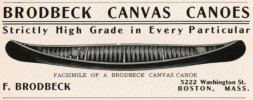
A very short, incomplete history of Brodbeck is as follows.
Frederick Brodbeck Jr. was born December 31,1869 in Dedham, MA. In the 1896 Boston City Directory and earlier ones he is listed as a “mathematical instrument maker” which I take to mean he was making rulers, drafting scales, protractors, slide rules, drafting compasses etc. He first advertised as a canoe builder in the Directory in 1897 but given the time required to compile the information for the directory he was likely building canoes in 1896. Who he learned the canoe business from is unknown but there were several canoe builders in the area at that time. In 1900 he was boarding with his widowed sister Emily, her daughter Anna and his uncle William Brodbeck, on Washington Street, West Roxbury, Massachusetts. He married Minnie L. Karcher in Dedham, MA in 1907. He and Minnie never had children. Frederick, working alone, built canoes in a small building behind the Dedham Boat Club. He was an early member of the club and a respected paddling coach and team captain for the club. There are numerous articles in the Boston Globe about canoe races spanning several years. He died May 12, 1930, at age 60.
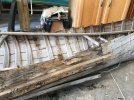
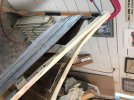
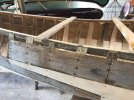
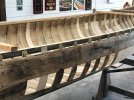
This canoe came to me in a rather sorry state. A previous owner had removed the canvas, the stem bands, the keel and eleven broken ribs. The gunwale caps and side caps and keel were missing. The inwales, because most of the rib tops were rotted off or broken, was completely separated from the canoe for over half the length. The stern stem was completely shot and the bow stem half rotten and warped. And just to top it off the canoe had sat outside covered with a tarp for at least a decade. Fortunately, several battens had been installed on the outside of the canoe, albeit with drywall screws, that held it in fair alignment. The inwales were in decent shape except for the ends at the stern which had rotted off. The mahogany thwarts and decks were in good shape. The seat frames, which appear to be made of Chestnut, were also in good shape. The center thwart, which was removable, was missing.
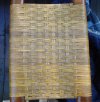
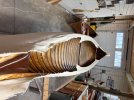
The unique things about this canoe and other early Brodbecks are as follows. Inwales extend past the stems. The rib tops are tapered unlike most other Charles River builders. The thwarts and seat frames are arched up similar to how thwarts are made on birchbark canoes and are uniquely shaped. The shear plank is feathered very thin on the top edge and does not extend up and over the outboard sides of the inwales. They actually stop short of the bottom of the inwale leaving a gap of between 1/4” and 3/8” that the canvas would span over. The backside of the canvas is visible from the inside of the canoe. And finally the seats are caned entirely different from the way we expect canoe seats to be done. (see picture).
After the interior was stripped the following wood repairs were made:
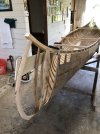
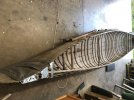
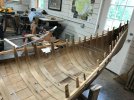
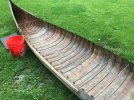
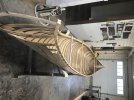
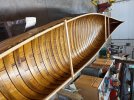
I replaced twelve full ribs, two cant ribs and did backside repairs on two others. I repaired or replaced the tops of nearly every rib. I replaced the entire stern stem and at least a foot of the bow stem. The tips of the inwales on the stern were replaced. I replaced nearly 50 feet of planking. I made a new center thwart. The new ribs and planking were stained and the varnish completed. The canvas was installed this past week and filler laid on. While that is drying I will cane the seats and start making new gunwale caps and keel.
So that’s where I’m at. It’s been a long haul but the plan is to have it ready for the water by Assembly in July. We haven’t settled on a color yet or picked a name for the old girl so stay tuned for that.
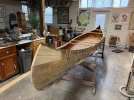
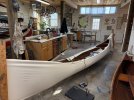
Attached are pictures. I'll have to post a couple times to get them all on here.
Jim C.
I am waiting for the filler to dry at the moment so I have time to compose this thread.
A very short, incomplete history of Brodbeck is as follows.
Frederick Brodbeck Jr. was born December 31,1869 in Dedham, MA. In the 1896 Boston City Directory and earlier ones he is listed as a “mathematical instrument maker” which I take to mean he was making rulers, drafting scales, protractors, slide rules, drafting compasses etc. He first advertised as a canoe builder in the Directory in 1897 but given the time required to compile the information for the directory he was likely building canoes in 1896. Who he learned the canoe business from is unknown but there were several canoe builders in the area at that time. In 1900 he was boarding with his widowed sister Emily, her daughter Anna and his uncle William Brodbeck, on Washington Street, West Roxbury, Massachusetts. He married Minnie L. Karcher in Dedham, MA in 1907. He and Minnie never had children. Frederick, working alone, built canoes in a small building behind the Dedham Boat Club. He was an early member of the club and a respected paddling coach and team captain for the club. There are numerous articles in the Boston Globe about canoe races spanning several years. He died May 12, 1930, at age 60.
This canoe came to me in a rather sorry state. A previous owner had removed the canvas, the stem bands, the keel and eleven broken ribs. The gunwale caps and side caps and keel were missing. The inwales, because most of the rib tops were rotted off or broken, was completely separated from the canoe for over half the length. The stern stem was completely shot and the bow stem half rotten and warped. And just to top it off the canoe had sat outside covered with a tarp for at least a decade. Fortunately, several battens had been installed on the outside of the canoe, albeit with drywall screws, that held it in fair alignment. The inwales were in decent shape except for the ends at the stern which had rotted off. The mahogany thwarts and decks were in good shape. The seat frames, which appear to be made of Chestnut, were also in good shape. The center thwart, which was removable, was missing.
The unique things about this canoe and other early Brodbecks are as follows. Inwales extend past the stems. The rib tops are tapered unlike most other Charles River builders. The thwarts and seat frames are arched up similar to how thwarts are made on birchbark canoes and are uniquely shaped. The shear plank is feathered very thin on the top edge and does not extend up and over the outboard sides of the inwales. They actually stop short of the bottom of the inwale leaving a gap of between 1/4” and 3/8” that the canvas would span over. The backside of the canvas is visible from the inside of the canoe. And finally the seats are caned entirely different from the way we expect canoe seats to be done. (see picture).
After the interior was stripped the following wood repairs were made:
I replaced twelve full ribs, two cant ribs and did backside repairs on two others. I repaired or replaced the tops of nearly every rib. I replaced the entire stern stem and at least a foot of the bow stem. The tips of the inwales on the stern were replaced. I replaced nearly 50 feet of planking. I made a new center thwart. The new ribs and planking were stained and the varnish completed. The canvas was installed this past week and filler laid on. While that is drying I will cane the seats and start making new gunwale caps and keel.
So that’s where I’m at. It’s been a long haul but the plan is to have it ready for the water by Assembly in July. We haven’t settled on a color yet or picked a name for the old girl so stay tuned for that.
Attached are pictures. I'll have to post a couple times to get them all on here.
Jim C.