A different way to paint?

Howie

Wooden Canoes are in the Blood
I've been using the roll & tip method for several years. But I'm often left with visible brush strokes. So I've been wondering if there might be something better than a brush to do the 'tipping'. Maybe my problem is that when I'm 'tipping' with the brush I'm taking off too much paint. Maybe if I left more paint on the surface it would flow better and thus hide the strokes. But doing so would invite drips to occur.

So... I saw one of these a while back (see below) and it got me thinking. Has anyone ever tried some version of this 'paint pad'?

1793066803194.png

Now, I haven't tried one of these yet as I can see a likely problem: The pads that I've seen are attached to a rigid backing. And although there is some amount of foam between this backing and the pad holding the paint, the thing as a whole can not come close to conforming to a canoe's curved sides if 'tipping' from fore to aft. However, maybe it work ok if you 'tipped' from up&down from rail to keel.

Anybody ever try it? Think it might work?
 
I try it in a room , not succesfull... but a plastic glove , an old sox or old washcloth
I painted many metters of iron tubes or fences with that before , you can apply a minimum of paint very quickly
you can control the pressure . So an hard sponge in a plastic bag in a washcloth can do the job on round parts
 
Do you thin enough? Kirby’s paint I found I have to thin a lot to get it a bit smoother.

Would it be better to spray? I’ve never done that but I’m sure there are people here who do.
 
Sounds to me like your base coat is probably too thick (too much paint or paint consistency is too thick) and you are tipping using too much pressure. The idea of tipping is basically just to remove bubbles, rather than actually removing paint, so the brush "strokes" need to be just as light as you can make them. The paint pad is likely too big and too clumsy to do the job well. All things considered, I've noticed that my first rolled and tipped coat does, and should, look lousy once applied, due to the fact that it was a very light coat, well rolled out. It will be smooth, but on the verge of blotchy due to the thinness. The second coat makes everything drastically better, and I seldom need a third coat. I use Gougeon thin foam epoxy rollers and light rolling pressure to minimize bubble creation and a soft bristle brush for the tipping.

I have sprayed boats, using both a normal compressor system and an airless sprayer. Once all the consistency stuff is figured out, the compressor system will do a nice job, but the prep is tedious and dealing with the overspray if you don't have a good spray booth is a hassle. Rolling and tipping can generate a similar finish without having to worry about where or onto what the spray is drifting.

I spray-varnished my drift boat decades ago, using the cheapest airless sprayer I could find. It yielded a decent and uniform finish that had a bit of orange peel texture. Not what I originally expected, but acceptable. A good airless system would probably do better, though the same overspray containment issues that we saw with the compressor system would exist.

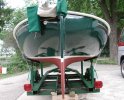
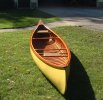
The green boat and the canoe were rolled and tipped. The wood strip drift boat was sprayed with the cheap airless gun.nordica 4.jpgguide 004.jpg!DSCN058.JPG
 
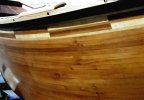
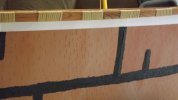
Here is a fun combo of methods, used on my 22' wood strip fur trade canoe. The base coat is a tan shade of Home Depot epoxy garage floor paint, which rolled and tipped very well, right out of the can. Then using both slightly lighter and slightly darker shades of the same paint and light use of a compressor spray gun I made the variations in color. The little grain lines were made with a roller, built by sticking small bits of a textured rubber door mat to a base roller.. Then the whole boat got sprayed with a flat, clear overcoat to kill any gloss. The black pitch lines were epoxy and microspheres and/or some black marine calk to create texture above the waterline, smooth below it. Finally, the white stripe was painted. You don't want to clearcoat over white as eventually it can darken enough to look blotchy, even if it was carefully sprayed. All in all, it was a fun project and likely made it a better bet for resale on the reenactor market, as I'm getting too old to horse it around and should get it out of the garage.
DSCF2374a.jpggrain roller.jpg
 
I roll with high density foam 4" roller and I roll it out pretty thin. Then I tip with a foam brush, usually 4". I'm never getting the finish I want but it's probably because I don't apply more than 3 or 4 coats of color. I'm just not fussy enough.
 
Back
Top