W T Bush wide board continued

Treewater

Wooden Canoes are in the Blood
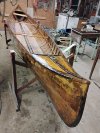
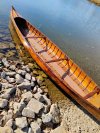
I'm back at work on the W T Bush wide board. I'm creating a new thread for more pictures. I need not apologize further. The intention is to get the canoe in the water. This is my first attempt at rebuilding a wide board. Without the canvas to cover mistakes and possible leaks I've opted to overdo the filler and varnish. Simplicity of rebuild has been my goal. I'm gone a lot from home and need this boat to go north after ice out. I have life problems and when events get bad the canoe is the result.
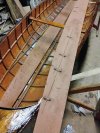
These basswood wide boards seem to be a transition between birch bark and wood/canvas. I imagine the builders were settling in among old growth timber. Very large trees were common in those early days of European settlement. This "three board" of course is built from local boards from quite large trees. The floor boards are equally wide. One split board and was repaired. I'm not going to refinish the floor boards. They chronical the history of the boat that I've now covered with filler and urethane.
I'm trying to recover the stenciled name. QUINNEDAUG seems to be an older spelling of the native American word for "Long Lake."
 
IMG_20260210_181854932_AE.jpg
 

Attachments

  • IMG_20260210_183450192_AE.jpg
    IMG_20260210_183450192_AE.jpg
    217.9 KB · Views: 45
Leaked bad , only got few hundred yards before I turned back
 

Attachments

  • IMG_20260211_145233486_AE.jpg
    IMG_20260211_145233486_AE.jpg
    317.2 KB · Views: 23
Someone who paddles these regularly can answer. Should I soak the canoe few days before going out? I'm sure the wood will expand. Maybe stop leaking??
 
Mine hasn't been on the water for a few years. It wasn't too bad and was getting better before a winter out of use at which point it leaked badly. I wondered if moving it when it was very dry, flexed it more causing more leaks. It didn't seem to get much better after two days soaking.
 
Basswood is pretty common around here, Western NY. They grow quite large. There are quite a few enormous ones in a grove that I regularly hunt so large boards off of one of these would not be all that unusual. They wood is very soft and easy to work, has precious little value for much of anything. Hobbyists like it because it is very workable and cheap. The trees seem to rot and fall as they approach their maximum size. I Have to deal with one that is currently down across a stream and another that has dropped across one of my trails. My guess for why it was used it simply that it is so easily workable and that (if you opted to fell it) that it is so easy to get a large board from one.
 
I would suggest that given the materials and method of manufacture, you just admire it as a piece of history and art. A very old wideboard canoe is in another realm, it’s an artifact. Although the old saying, “it’s your canoe, do what you want with it”, is used quite a bit, I would say that as members of this wonderful club, we have the responsibility to determine what is actually the right level of restoration, preservation, or even not do anything, simply for history sake. This post isn’t meant to offed, just pose the question…….
 
Layer of light glass over the exterior. they all leak but there are no shiplap joints as with cedar strip construction to swell and tighten up. butt jointed planks with a batten. it had a layer of canvas over it when i got it. for a boat from the 'teens it hasnt been paddled in close to 70 years. there is no harm at this point, glass it and paint it. second grade basswood and iron fastened board canoes were often painted since they were economy models. this will provide usability, if not you can sponge between strokes. lol
 
Layer of light glass over the exterior. they all leak but there are no shiplap joints as with cedar strip construction to swell and tighten up. butt jointed planks with a batten. it had a layer of canvas over it when i got it. for a boat from the 'teens it hasnt been paddled in close to 70 years. there is no harm at this point, glass it and paint it. second grade basswood and iron fastened board canoes were often painted since they were economy models. this will provide usability, if not you can sponge between strokes. lol
Uhg
 
Oh please Pearson, dont be so puritanical . That boat went far down the rabbit hole some time ago, i was able to paddle an otherwise frail Walter Dean years ago with a really well done glass coat that stabilized it and made it very serviceable, brass battens and all. not noticeable at 20' , and it would make the burning much more hot and lively. Cant talk, off to throw some more chestnut boards in the stove, cold morning here.
 
Puritanical just may involve leaving things alone and admiring the craftsmanship and history instead of thinking we need to make
everything water worthy again. There, I said it.
 
Oh please Pearson, dont be so puritanical . That boat went far down the rabbit hole some time ago, i was able to paddle an otherwise frail Walter Dean years ago with a really well done glass coat that stabilized it and made it very serviceable, brass battens and all. not noticeable at 20' , and it would make the burning much more hot and lively. Cant talk, off to throw some more chestnut boards in the stove, cold morning here.
 

Attachments

  • IMG_1228.jpeg
    IMG_1228.jpeg
    235.5 KB · Views: 19
Yes, This canoe was well gone when I got it 15 years ago. As a learning project it's been great.
I took it outside, put it upright on the sawhorses and started filling it with water. It became quickly obvious where the leak was.
The bottom board is scarfed onto the stem band. Leaking badly. So....I'm not going to remove the board. Maybe pry it up a little and put in bedding compound. Maybe glue it down. Or tip it on end and reach inside to add a lot of paint until the leak is filled.
Any other ideas?
 
Back
Top